
Egyptian Baladi Bread in a Home Oven
The bread fails to puff because the oven is not hot enough. A loaf inflates when the steam inside it forms instantly and forces the two layers apart. Your oven needs to be at its maximum, 250°C, with the tray heating inside it for 30 minutes before baking.
- Prep
- 110 min
- Cook
- 25 min
- Total
- 135 min
- Calories
- 210
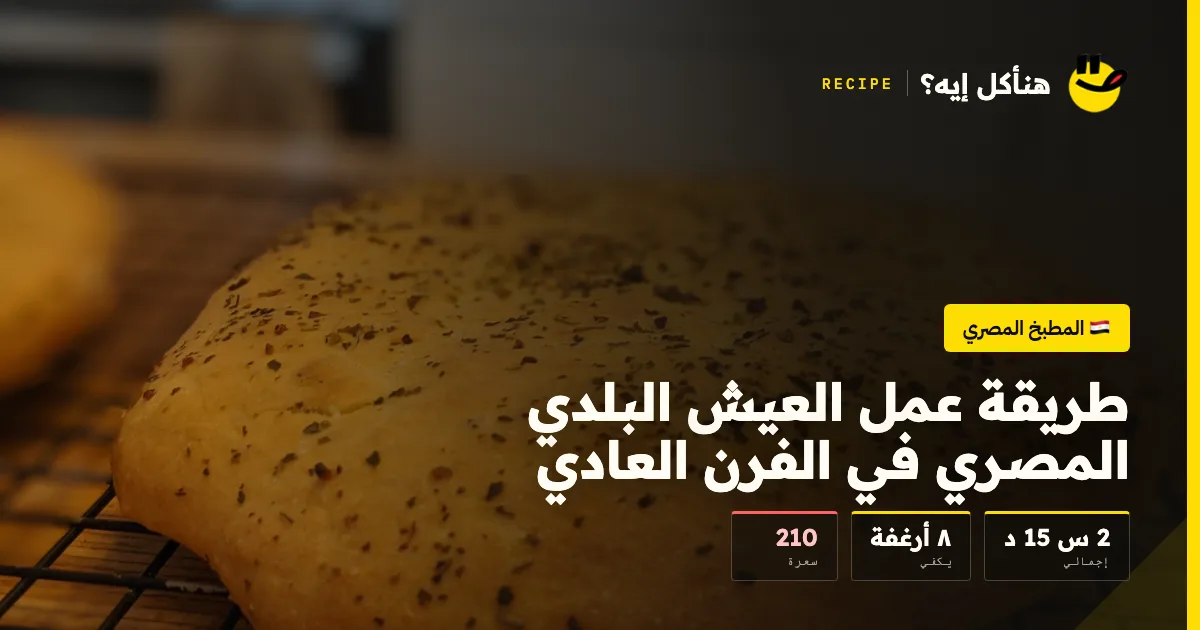
Photo: Shisma — CC BY 4.0 · Wikimedia Commons
Baladi bread is the foundation of the Egyptian table, and the hardest part of making it at home is getting it to puff and form its pocket. The secret is not in the dough — it is in the heat.
Method
-
1
A wet dough
Mix both flours, the bran, yeast and sugar, add the warm water gradually and knead for 12 minutes, adding the salt and oil at the end. The dough is deliberately wet and slightly sticky.
⏱ 15 min -
2
First rise
Cover and leave somewhere warm for one hour until doubled. The high hydration is the source of the steam that will inflate the loaf.
⏱ 62 min -
3
Divide and rest
Divide into balls, dust them with coarse bran, set them on a bran-dusted cloth, cover and rest 20 minutes.
⏱ 24 min -
4
Preheat oven and tray
Heat the oven to its maximum, 250°C, with the tray or baking stone inside for a full 30 minutes. That hot surface is the shock that makes the loaf puff.
⏱ 32 min -
5
Roll evenly
Roll each ball by hand or with a pin to an even 5 mm. Any thicker patch will not inflate and will stay stuck together.
⏱ 12 min -
6
Second rest
Leave the rolled loaves covered for 15 minutes before baking. This relaxes the dough so it inflates more easily.
⏱ 16 min -
7
A fast bake
Put the loaf on the hot tray and bake for 3–4 minutes only, until it balloons and colours lightly. Longer and it turns into rusk.
⏱ 22 min -
8
Cool under a cloth
Lift them onto a cloth, not a wire rack, and cover with another cloth. The trapped steam softens the crust and keeps them pliable like bakery bread.
⏱ 6 min
Cooked it? Rate it
Your rating tells the next cook whether this recipe is worth their time.
✓ Thanks — your rating is in.
Tips that actually matter
- Oven at maximum and the tray preheated for half an hour — rule number one.
- The dough is wet on purpose — that moisture is the steam that inflates it.
- An even 5 mm thickness; any thicker patch will not puff.
- Cover with a cloth after baking — trapped steam softens the crust.
People also ask
Why doesn't my bread puff?
The oven is not hot enough or the tray is cold. You need maximum heat (250°C) with the tray inside for 30 minutes first. That thermal shock forms steam instantly and pushes the two layers apart.
Why does it come out dry like rusk?
It baked too long. Baladi bread needs only 3–4 minutes at very high heat. Take it out the moment it puffs and colours lightly, and cover it with a cloth to stay soft.
Can I make it without bran?
You can, but it will not be baladi. Bran gives the flavour, texture and distinctive colour, and adds a lot of fibre. If you cannot get it, push the wholemeal proportion as high as possible.
Cook mode
Egyptian Baladi Bread in a Home Oven
-
1
A wet dough
Mix both flours, the bran, yeast and sugar, add the warm water gradually and knead for 12 minutes, adding the salt and oil at the end. The dough is deliberately wet and slightly sticky.
-
2
First rise
Cover and leave somewhere warm for one hour until doubled. The high hydration is the source of the steam that will inflate the loaf.
-
3
Divide and rest
Divide into balls, dust them with coarse bran, set them on a bran-dusted cloth, cover and rest 20 minutes.
-
4
Preheat oven and tray
Heat the oven to its maximum, 250°C, with the tray or baking stone inside for a full 30 minutes. That hot surface is the shock that makes the loaf puff.
-
5
Roll evenly
Roll each ball by hand or with a pin to an even 5 mm. Any thicker patch will not inflate and will stay stuck together.
-
6
Second rest
Leave the rolled loaves covered for 15 minutes before baking. This relaxes the dough so it inflates more easily.
-
7
A fast bake
Put the loaf on the hot tray and bake for 3–4 minutes only, until it balloons and colours lightly. Longer and it turns into rusk.
-
8
Cool under a cloth
Lift them onto a cloth, not a wire rack, and cover with another cloth. The trapped steam softens the crust and keeps them pliable like bakery bread.


Comments
Cooked it? Tell us how it went, or ask a question — we read every comment.