
Pickled Baladi Cucumbers
The secret to crunchy pickled cucumbers is salt ratio: 50 g coarse salt per 1 liter of water (about 3 tbsp), and keeping every cucumber submerged under the brine. Less salt makes cucumbers soft and moldy, more salt stops fermentation making them salty without that pickled taste, and any part sticking out of the water will mold.
- Prep
- 30 min
- Cook
- 5 min
- Total
- 10115 min
- Calories
- 15
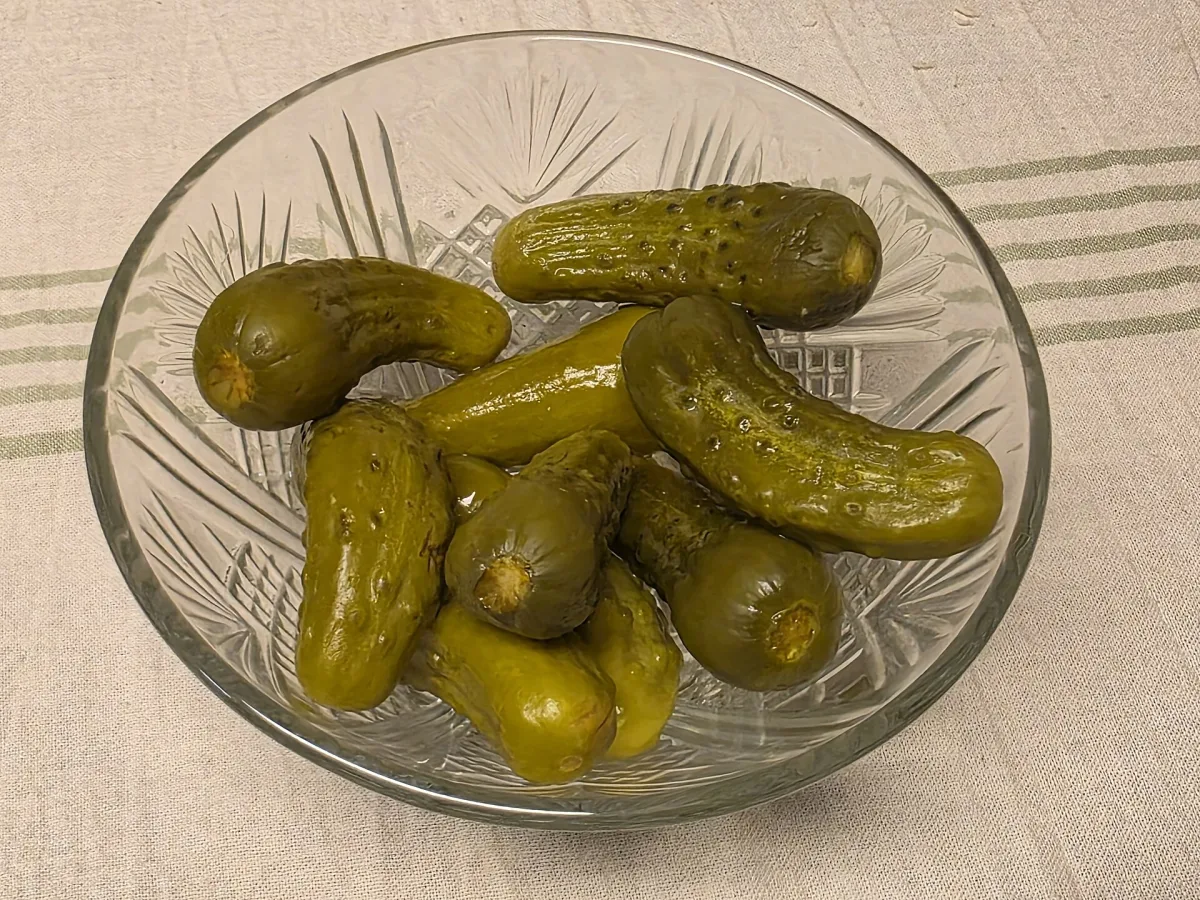
Photo: Horacio Cambeiro / Wikimedia Commons · CC BY-SA 3.0 · https://commons.wikimedia.org/wiki/File:Whole_pickled_cucumbers_in_a_glass_bowl.jpg
Baladi pickled cucumbers are made at home using just water, salt, cucumbers, garlic, and chili. The beneficial bacteria on the cucumber skin ferment it in about a week and give it acidity, and the exact brine protects it from mold and maintains its crunch.
Method
-
1
Choosing and washing cucumbers
Choose small and uniformly sized, firm and not wilted cucumbers, preferably pickled on the same day you bought them. Wash them with cold water and rub them with your hand. Large cucumbers have a core full of seeds and water so they soften quickly, and uniform sizes pickle together.
⏱ 5 min -
2
Cutting the blossom end
Cut a thin slice about 2 mm from the opposite end of the stem (the blossom end). This end contains an enzyme that breaks down the cucumber wall, and it is the reason most pickles turn out soft.
⏱ 5 min -
3
Puncturing
Puncture each cucumber 3-4 times with a fork, or make a lengthwise slit in the middle without reaching the ends. This way the brine reaches the core quickly, so the cucumbers pickle evenly and the inside does not stay green.
⏱ 5 min -
4
The brine
Dissolve the 50 g salt in a cup of boiling water, complete the liter with cooled water, and add the vinegar. Boiled or filter water without chlorine — chlorine weakens the bacteria that do the fermentation. The brine must be lukewarm or cold not hot, because hot water boils the cucumbers and makes them soft.
⏱ 5 min -
5
Packing the jar
In a 2 liter glass jar rinsed with boiling water, put the grape leaf, garlic, chili, coriander, and pepper at the bottom, arrange the cucumbers standing upright and tightly packed next to each other so they don't float, and put the second grape leaf on top. Grape leaves contain an astringent substance that maintains the crunch of the cucumbers.
⏱ 10 min -
6
Pouring the brine and submerging
Pour the brine until it covers the cucumbers by 2-3 cm, and leave 2 cm empty under the lid. If the cucumbers float, place a small plate or a clean plastic bag with some brine in it on top as a weight — any part above the water will mold.
⏱ 3 min -
7
Fermentation
Close the jar without tightening it too much, and place it in a dark place away from the sun at room temperature. Open it once every day for two seconds to let the gas out. The duration in summer is 5-7 days, and in winter 10-12 days. The brine will become cloudy and produce bubbles — this is fermentation, not spoilage.
⏱ 2 min -
8
When it is ready and storage
The pickles are ready when the color of the cucumber turns olive from the outside to the inside — cut one, and if the inside is still light green leave it two more days. Once ready, put it in the fridge so fermentation slows down and it stays crunchy, and it lasts in there for two to three months as long as it is submerged.
⏱ 2 min
Cooked it? Rate it
Your rating tells the next cook whether this recipe is worth their time.
✓ Thanks — your rating is in.
Tips that actually matter
- Use iodine-free coarse salt — iodine and anti-caking agents make the brine cloudy and can darken the cucumbers.
- A plain tea bag in the jar gives the same astringent property that maintains the crunch.
- If a thin white layer appears on the surface of the brine, this is usually surface yeast — remove it with a spoon. As for colored or fuzzy mold, or slimy cucumbers, the whole jar should be thrown away.
- Want it spicier? Increase the chili and slit them in half. Want it faster? Cut the cucumbers into lengthwise quarters — they pickle in just 3-4 days but soften faster.
People also ask
Why do pickled cucumbers soften or mold?
Most common reasons: salt less than 50 g per liter, cucumbers sticking out above the brine, blossom end not cut, large and wilted cucumbers, or jar sitting in the sun. Excess heat speeds up the wrong bacteria before the beneficial bacteria.
The brine became cloudy and has a strong smell, is this normal?
Yes, cloudiness, bubbles, and a sour smell are signs that fermentation is working. What is not normal: colored or fuzzy mold, a moldy smell rather than a sour one, or slimy cucumbers — then throw away the jar.
Do I have to put vinegar in Baladi pickles?
Not necessarily, but a quarter cup of vinegar per liter sours the brine from the first day so it protects it from mold in the first days before fermentation starts, and it doesn't stop it. If you like the explicit fermentation taste, dispense with it, and pay attention to cleanliness and salt percentage.
I want quick pickled cucumbers in two days, is that possible?
Pickles with vinegar are possible: brine that is half vinegar and half water, with two tablespoons of salt per liter, poured over cucumbers and put in the fridge for 48 hours. Its taste is distinctly vinegar and it is not the Baladi pickle whose acidity comes from fermentation, but it saves the meal.
Cook mode
Pickled Baladi Cucumbers
-
1
Choosing and washing cucumbers
Choose small and uniformly sized, firm and not wilted cucumbers, preferably pickled on the same day you bought them. Wash them with cold water and rub them with your hand. Large cucumbers have a core full of seeds and water so they soften quickly, and uniform sizes pickle together.
-
2
Cutting the blossom end
Cut a thin slice about 2 mm from the opposite end of the stem (the blossom end). This end contains an enzyme that breaks down the cucumber wall, and it is the reason most pickles turn out soft.
-
3
Puncturing
Puncture each cucumber 3-4 times with a fork, or make a lengthwise slit in the middle without reaching the ends. This way the brine reaches the core quickly, so the cucumbers pickle evenly and the inside does not stay green.
-
4
The brine
Dissolve the 50 g salt in a cup of boiling water, complete the liter with cooled water, and add the vinegar. Boiled or filter water without chlorine — chlorine weakens the bacteria that do the fermentation. The brine must be lukewarm or cold not hot, because hot water boils the cucumbers and makes them soft.
-
5
Packing the jar
In a 2 liter glass jar rinsed with boiling water, put the grape leaf, garlic, chili, coriander, and pepper at the bottom, arrange the cucumbers standing upright and tightly packed next to each other so they don't float, and put the second grape leaf on top. Grape leaves contain an astringent substance that maintains the crunch of the cucumbers.
-
6
Pouring the brine and submerging
Pour the brine until it covers the cucumbers by 2-3 cm, and leave 2 cm empty under the lid. If the cucumbers float, place a small plate or a clean plastic bag with some brine in it on top as a weight — any part above the water will mold.
-
7
Fermentation
Close the jar without tightening it too much, and place it in a dark place away from the sun at room temperature. Open it once every day for two seconds to let the gas out. The duration in summer is 5-7 days, and in winter 10-12 days. The brine will become cloudy and produce bubbles — this is fermentation, not spoilage.
-
8
When it is ready and storage
The pickles are ready when the color of the cucumber turns olive from the outside to the inside — cut one, and if the inside is still light green leave it two more days. Once ready, put it in the fridge so fermentation slows down and it stays crunchy, and it lasts in there for two to three months as long as it is submerged.



Comments
Cooked it? Tell us how it went, or ask a question — we read every comment.