
Gulf Cuisine: Machboos, Harees, Balaleet and Gulf Spices
Gulf cooking was shaped by the maritime spice route: Indian spices — turmeric, cinnamon, cardamom, clove — arrived by ship and merged with local ingredients: dates, dried black lime and fish. Its most recognisable signature is dried black lime, pierced and dropped into the broth to give a deep, earthy sourness.
The Gulf was a key stop on the maritime spice route between India, East Africa and the Levant. Gulf cooking is the result of that mixing: Indian spices, Indian rice, Persian cooking methods, and local desert ingredients.
Dried black lime — the signature
A small lime boiled and dried in the sun until it blackens and loses weight. It is pierced with a knife and dropped whole into the broth, giving a deep, earthy sourness quite unlike lemon juice.
The rule: two are enough for a full pot. More brings bitterness, and a broken lime releases a far stronger flavour than a pierced one.
The core dishes
Machboos
Rice with meat, chicken or fish, spices and dried lime. The differences from Saudi kabsa are subtle: machboos is usually darker (more dried lime and stronger spicing), and in Bahrain and Kuwait it is very often made with fish — which is rare in kabsa.
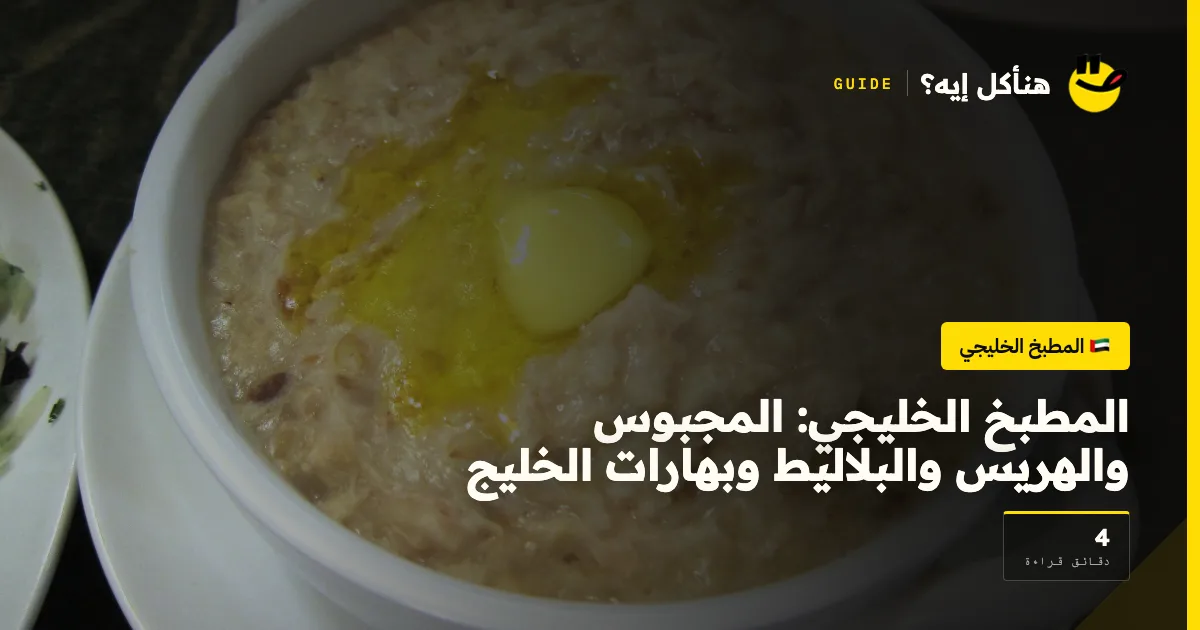
Harees
Cracked wheat and meat cooked together for hours until they become a uniform paste. The secret is that it is mashed on the heat as it cooks with a wooden pestle, not afterwards. It is served in Ramadan with ghee and sugar or cinnamon.
Balaleet
An Emirati and Bahraini breakfast that is strange and delicious: vermicelli sweetened with cardamom, saffron and rose water, topped with a savoury omelette. The sweet-savoury pairing is deliberate and distinctive.
Luqaimat
Fried dough balls dipped in date syrup or saffron sugar syrup. The secret to crispness: the batter rests for an hour, and the frying is at medium heat, not high.
Marqooq and mathlootha
Dough-and-broth dishes appear across the Gulf under different names, all on the same principle: thin dough dropped into a meat and vegetable broth.
Gulf spices
The Gulf spice blend, bzar, contains cumin, coriander, cinnamon, cardamom, clove, black pepper, turmeric and sometimes ground dried lime. It is closer to Indian spicing than to Moroccan or Levantine.
Saffron goes into both rice and sweets, and is dissolved in hot water before use — whole threads give no colour.
Dates
Dates are not a dessert in the Gulf — they are an ingredient. They go into dough (date bread) and into sweets (luqaimat with date syrup), and they are served with coffee as a fundamental rite of hospitality.
Where to start
Machboos is the easiest entry — one pot and clear steps. Then luqaimat, then balaleet. Harees comes last, because it takes hours and constant stirring.
Ingredients worth buying
- Dried black lime: it keeps for years and it is the ingredient that gives the Gulf flavour.
- Gulf bzar: or mix your own.
- Date syrup: for luqaimat and bread.
- Rose water and orange blossom water: for sweets.
How a Gulf table is ordered
A Gulf meal is served on one large communal tray, often on the floor, with the main dish — machboos, madghoot or mathlootha — in the centre and the salads, pickles, daqqous and yogurt around it. Eating is with the right hand, and each person takes from the portion in front of them.
Coffee and dates are served both before and after the meal, and this is a strict rule of hospitality. Gulf coffee is pale, scented with cardamom and saffron, and poured into a small cup filled only to a third.
Common mistakes
- Dried lime: more than two gives obvious bitterness.
- Machboos: not soaking the rice gives broken grains.
- Harees: mashing after cooking rather than during gives an uneven texture.
- Luqaimat: frying over high heat gives brown outsides and raw centres.
- Saffron: using whole threads gives neither colour nor flavour.
Fish in Gulf cooking
The Gulf is a maritime environment, and fish is fundamental rather than exceptional. Safi, hamour and zubaidi are among the best-known species, cooked as machboos, grilled or fried.
Madrooba is a well-known Bahraini dish: fish and rice cooked together until they collapse into a uniform paste. And machboos rubian, with prawns, is among Kuwait's most famous dishes.
The general rule with Gulf fish: use less dried lime than with meat, because fish is more delicate and excess sourness overwhelms it.
Where to begin with Gulf cooking
Machboos is the easiest entry: one pot, steps identical to kabsa, and the only differences are the quantity of dried lime and the spicing. Then luqaimat — a simple batter and a fry, and a result children love.
After those, balaleet (odd, delicious and quick), and finally harees — not difficult, but it takes hours and near-constant stirring, so save it for a day off.
The single note that makes more difference than anything else: the rice must soak for half an hour before cooking in every Gulf rice dish. Rinsing alone is not enough — soaking is what stops the grains breaking and lets them lengthen as they cook.
Gulf coffee
Gulf coffee is not coffee in the usual sense: a very lightly roasted bean, sometimes almost green, with large amounts of cardamom and sometimes saffron, clove and rose. Its colour is golden yellow rather than black, and it tastes closer to a herbal infusion than to coffee.
It is served from a brass dallah into a small handleless cup filled only to a third — filling it completely signals that the guest is not welcome. Shaking the cup after drinking means "enough"; without that, the host keeps pouring.
FAQ
إيه الفرق بين الكبسة والمجبوس؟
الاتنين أرز مع لحم في مرقة متبّلة، والفروق دقيقة: المجبوس غالبًا أغمق لونًا وبهاراته أقوى ولوميه أكتر، وبيتعمل بالسمك كتير في البحرين والكويت. الكبسة أهدى في التتبيل.
إيه هو اللومي الأسود؟
ليمون صغير بيتسلق ويتجفّف تحت الشمس لحد ما يسوَدّ. بيتثقب وبينزل المرق فيدّي حموضة عميقة ترابية. حبّتين كفاية لحلة كاملة — الزيادة بتدّي مرارة.
ليه الهريس بيتهرس على النار؟
لأن القمح واللحم لازم يتفكّكوا ويتجانسوا وهما سخنين. الهرس بعد الطبخ بيدّي قوام غير متجانس، والهرس المستمر أثناء الطبخ هو اللي بيوصل للقوام العجيني المطلوب.
Comments
Cooked it? Tell us how it went, or ask a question — we read every comment.