
Sudanese Cuisine: Kisra, Mullah, Aseeda and Shaiyah
Sudanese cooking rests on one pairing: a starch plus a mullah. The starch is kisra (a fermented sorghum flatbread) or aseeda (a cooked dough), and the mullah is the stew eaten with it. Its most distinctive feature is ground groundnuts, which go into salads and stews alike.
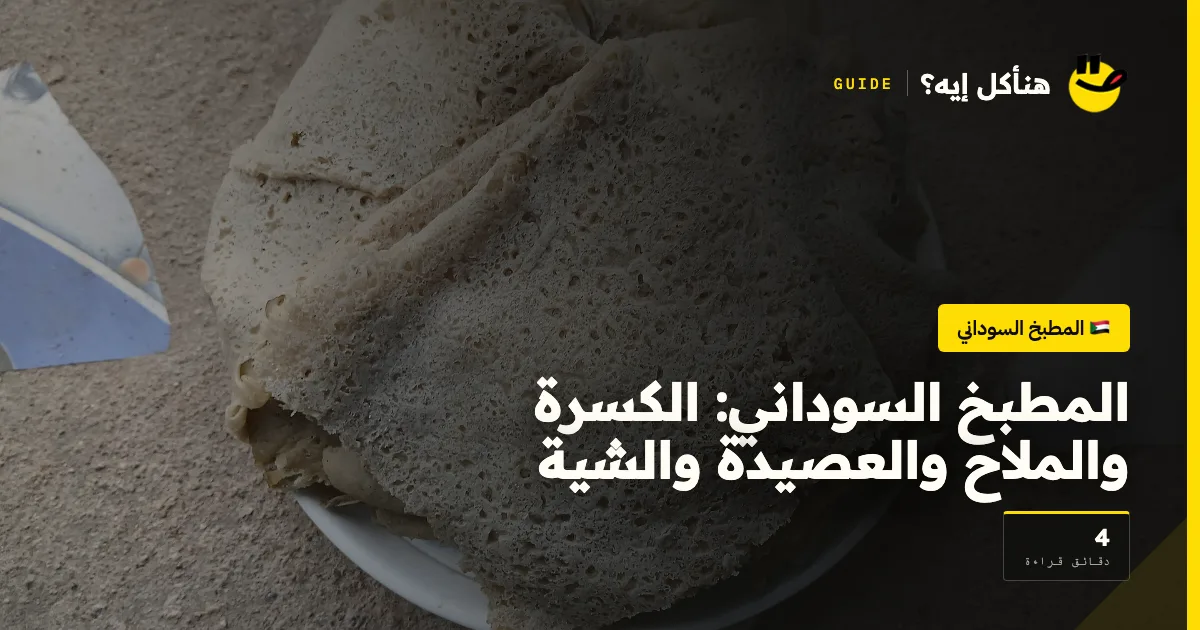
Sudan is a vast country between the Arab world and Africa, and its cooking reflects that position clearly: African grains — sorghum and millet — with Arab spices and local methods. Groundnuts, of which Sudan is among the world's largest producers, go into dishes with no equivalent in other Arab cuisines.
The core dishes
1. Kisra
A very thin sheet of fermented sorghum flour, baked on a hot griddle on one side only, coming out covered in small eyes. Those eyes are what catch the mullah.
The fermentation of twenty-four to forty-eight hours is what gives the sourness and the bubbles. Without it you get a flat, tasteless sorghum sheet. Keeping half a cup of fermented batter as a starter for next time speeds the fermentation and improves the flavour.
2. Aseeda
A cooked flour dough worked over the heat with a wooden paddle until it is smooth and cohesive, served as a dome with a well in the centre for the mullah.
Lumps are its only real problem, and the solution is: slake half the flour in cold water first and pour that into the boiling water, then add the rest as a gradual sprinkle with continuous working.
3. Mullah
"Mullah" means the stew. There are many kinds: okra mullah, weika mullah (dried ground okra, which gives a distinctive viscosity), rob mullah (with yogurt) and bamby mullah (with potato).
The weika is sprinkled in gradually with stirring so it does not clump, and it gives the mullah the characteristic clinging texture that makes it stick to the kisra.
4. Shaiyah
Small pieces of meat grilled over very high heat in six to eight minutes only. Slow grilling dries them out and turns them to jerky.
The spices go on after grilling, not before — over high heat they burn and turn bitter. It is served with dugga (toasted groundnuts ground with chilli and cumin).
5. Dugwa salad
Tomato, cucumber and onion with ground groundnuts that turn with the lemon into a creamy dressing. This is not a side salad — the groundnuts give it enough protein and fat to be a meal.
6. Tagalia
Onion, garlic, tomato and paste softened together as the base of most mullahs. This is the stage that determines the depth of flavour in the whole stew.
Groundnuts — the signature
Sudan is among the world's largest groundnut producers, and they enter the cuisine in ways with no parallel: ground into salads (dugwa), with shaiyah (dugga), in some mullahs, and in sweets.
The practical rule: grind them fresh. Old pre-ground nuts lose their oil and taste of cardboard. Toasting before grinding doubles the flavour.
Fermentation
Kisra, aseeda and merissa (a drink) all rely on natural fermentation. In Sudan, fermentation is not only about flavour — it is a method of preservation and of improving digestibility in a hot climate.
The light sourness it produces is what balances the richness of the mullahs, on the same logic as Ethiopian injera and yogurt in other cuisines.
The resemblance to Ethiopia
Sudanese kisra and Ethiopian injera are relatives: both are fermented breads full of eyes, eaten by hand with stews on top. The difference: kisra is white sorghum flour and far thinner, injera is teff, thicker and more sour.
Both reflect the same logic: the bread is the plate and the spoon at once.
Ingredients worth buying
- White sorghum flour: for kisra and aseeda.
- Weika (dried ground okra): it gives the distinctive viscosity.
- Groundnuts: buy them raw and toast and grind them yourself.
- Sudanese shatta: coarsely ground dried chilli.
- Cumin and coriander: the primary spices in most mullahs.
How a meal is ordered
A Sudanese meal is served on one tray on the floor: kisra or aseeda in the centre, with small bowls of different mullahs and salad around it. Eating is with the right hand.
Sudanese breakfast is known for ful medames, taamiya, white cheese and honey — eaten relatively late and treated as a substantial meal rather than a light one.
Common mistakes
- Fermenting kisra for less than twenty-four hours: no eyes and no sourness.
- Flipping kisra on the griddle: it kills the eyes — it bakes on one side only.
- Adding aseeda flour dry: lumps that never come out.
- Adding weika all at once: it clumps.
- Spicing shaiyah before grilling: the spices burn and turn the meat bitter.
Where to start
Dugwa salad is the easiest entry — fifteen minutes with no cooking, and it introduces you to the use of groundnuts. Then shaiyah, a fast and simple grill.
After those, bamby or okra mullah (ordinary stews with clear steps). Kisra and aseeda come last — kisra needs two days of fermentation and aseeda needs technique in the working.
Sudanese drinks
Sudanese hibiscus is among the finest in the world and is exported widely. It is drunk cold in summer and hot in winter.
Sudanese coffee (jebena) is roasted and ground in front of the guests, boiled with ginger and clove, and strained through a palm-fibre filter — a complete social ritual, like Ethiopian coffee.
FAQ
إيه هو الملاح؟
الملاح في السودان هو الطبخة أو الإدام اللي بتتاكل مع الكسرة أو العصيدة — زي ما نقول «طبيخ». وأنواعه كتير: ملاح بامية، وملاح ويكة، وملاح روب، وملاح بامبي.
ليه الكسرة مالهاش عيون؟
التخمير كان قصير، أو الصاج مش سخن كفاية، أو العجينة تقيلة. الفقاعات محتاجة تخمير ٢٤ ساعة على الأقل وحرارة عالية عشان تنفجر على السطح.
إيه هي الويكة؟
بامية مجفّفة ومطحونة بودرة. بتدّي الملاح لزوجة مميّزة وطعم مركّز، وبترشّ بالتدريج مع تقليب عشان ما تتكتّلش.
Comments
Cooked it? Tell us how it went, or ask a question — we read every comment.