
Vegetable Ghee vs. Animal Ghee: Hydrogenated, Non-Hydrogenated and Which Is Healthier
Animal ghee (samna baladi) is milk fat left after the water and protein have been removed, and it carries flavor and cholesterol. Vegetable ghee is vegetable oil solidified industrially — in the past through partial hydrogenation, which produces trans fats that raise the risk of heart disease, and nowadays mostly with palm oil or full hydrogenation. The rule: skip any product whose ingredients say "partially hydrogenated".
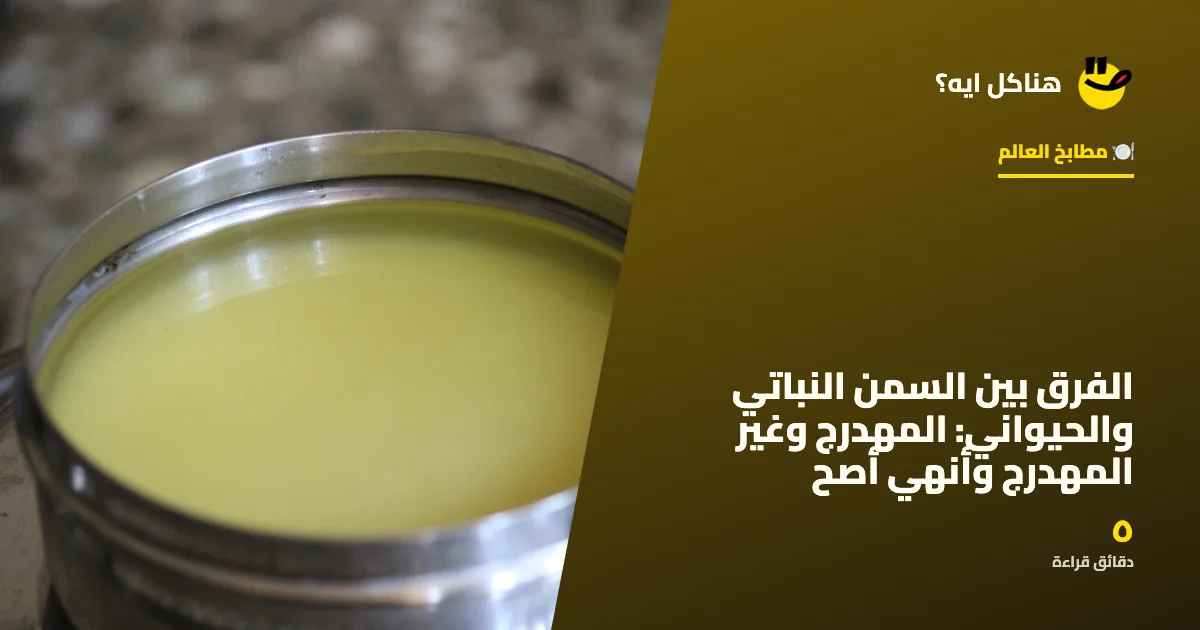
Photo: Phadke09 — CC BY-SA 4.0 · Wikimedia Commons
In Egypt, the word "samna" is used for two completely different products: a ghee that comes from milk, and a ghee made from vegetable oils. The difference between them isn't just taste — there's a real health difference called hydrogenation, and that's what you need to understand to read the label correctly.
Animal Ghee: Pure Milk Fat
Samna baladi (made from cow's or buffalo's milk) is butter cooked until its water evaporates and the milk proteins brown and are strained out. The result is almost pure milk fat, about 99%, and its aroma comes from those browned solids. About 60–65% of its fat is saturated, it contains cholesterol (about 250 mg per 100 g), and it also has a small amount of natural trans fats that occur in milk fat to begin with.
Vegetable Ghee: Oil Made Solid
Vegetable oils are liquid at room temperature, and ghee has to be solid. So manufacturers have two methods:
- Hydrogenation: adding hydrogen to the oil under heat and pressure with a catalyst (nickel), so the unsaturated fats become saturated and solidify. If the hydrogenation is partial, some of the fat turns into a chemical form called trans fats. If it's full, the oil becomes a very hard saturated fat with practically no trans fats, which is then blended with liquid oil to adjust its texture.
- Without hydrogenation: using palm oil and its fractions, since palm oil is naturally semi-solid, blended with other oils. This is the common method for products labeled "non-hydrogenated".
Color and ghee flavoring are often added to vegetable ghee to bring it closer to samna baladi.
Partially Hydrogenated: Why It's the Problem
The World Health Organization says industrial trans fats raise bad cholesterol and lower good cholesterol and increase the risk of heart disease, and it recommends keeping them below 1% of daily calories — ideally removing them from processed food altogether. In Egypt, according to reports published in 2023, the National Food Safety Authority set a maximum of 2 g of industrial trans fat per 100 g of fat and banned partially hydrogenated oils. But what's actually in your hands is the label: if it says "partially hydrogenated oils", or the trans fat is above zero, choose another brand.
How to Read the Label
- "Partially hydrogenated vegetable oils" in the ingredients = trans fats. Leave it on the shelf.
- "Fully hydrogenated", "palm oil" or "non-hydrogenated" = practically no trans fats, but high in saturated fat.
- The "trans fat" line in the nutrition facts table should be zero or close to it.
- "Samna baladi flavor" = added flavoring, not real samna baladi.
- "Blended ghee" = a mix of animal and vegetable fat; check the ratio and the type of vegetable fat in it.
Taste, Texture and Cooking
Animal ghee gives the taste and aroma that many Egyptian dishes are built on, and its smoke point is around 250°C. Vegetable ghee has a neutral taste, a white color and a texture that stays stable in summer and winter, and palm-based types also have a high smoke point (around 220–230°C). Some types leave a waxy feeling in the mouth, because part of their fat melts at a temperature higher than body temperature. In sweets, that stability is an advantage: kahk and ghorayeba made with vegetable ghee hold their shape better in summer.
Calories and Fat per 100 g
The calories are about the same: 880–900 calories in both, because both are almost pure fat. The difference is in the type of fat:
- Animal: 60–65 g of saturated fat, plus cholesterol.
- Palm-oil vegetable ghee: about 45–55 g of saturated fat, and no cholesterol.
- Partially hydrogenated: can contain a large share of trans fats — the worst choice.
The WHO recommends keeping saturated fat below 10% of your calories, which is about 22 g on a 2000-calorie day. A tablespoon of samna baladi has about 8 g of saturated fat, and vegetable ghee about 6–7 — so three tablespoons a day of either one pretty much uses up your allowance.
| Comparison | Animal (Baladi) | Vegetable, Not Partially Hydrogenated | Vegetable, Partially Hydrogenated |
|---|---|---|---|
| Source | Milk fat | Palm oil and vegetable oils | Partially hydrogenated oils |
| Trans fats | Small natural amount | Practically zero | High — avoid it |
| Saturated fat per 100 g | 60–65 g | About 45–55 g | Varies |
| Cholesterol | About 250 mg | Zero | Zero |
| Taste | Distinct ghee aroma | Neutral | Neutral |
| Price | Highest | Much cheaper | Much cheaper |
What About Margarine? It's Not Vegetable Ghee
Many people treat them as the same thing, but vegetable ghee is almost pure fat, while margarine is an emulsion that contains water, like butter, and its fat content varies by type. That's why swapping one for the other in recipes isn't one-to-one: margarine gives a softer, moister dough, while vegetable ghee gives a crumblier texture.
Price
Vegetable ghee is much cheaper than samna baladi, which is why pastry shops and bakeries rely on it or blend it with samna baladi.
Which One for Which Dish
- Ghorayeba, kahk and biscuits: vegetable ghee that isn't partially hydrogenated gives a crumbly texture and a white color, while samna baladi gives the flavor. A half-and-half blend is very common: the taste of samna baladi with the stability and price of vegetable ghee.
- Rice, fatta, molokhia ta'leya and feteer: samna baladi, because its flavor is what makes the dish. Vegetable ghee here just gives you fat without flavor.
- Laminated dough in hot weather: firm vegetable ghee holds between the layers better than samna baladi, which softens quickly.
- Everyday cooking and frying: neither one — liquid oils (sunflower, corn and olive) are much lower in saturated fat, and health guidelines recommend them as the basis.
The Bottom Line
Animal ghee is milk fat with flavor, cholesterol and a lot of saturated fat. Vegetable ghee that isn't partially hydrogenated has no cholesterol and no trans fats, but it's still saturated. Partially hydrogenated ghee is the one you need to avoid. Use samna baladi for flavor in the dishes that need it and vegetable ghee for sweets that need color and texture, and measure both by the spoon, not the cup.
FAQ
What does hydrogenated ghee mean?
It's vegetable oil that has had hydrogen added under heat and pressure so it solidifies. If the hydrogenation is partial, harmful trans fats form; if it's full, it becomes a hard saturated fat with practically no trans fats.
Is vegetable ghee healthier than animal ghee?
Not necessarily. Vegetable ghee that isn't partially hydrogenated has no cholesterol or trans fats but is saturated, the partially hydrogenated kind is the worst choice, and animal ghee has saturated fat and cholesterol. It's best to cut down on solid fats in general.
How do I know if ghee contains trans fats?
Look for "partially hydrogenated oils" in the ingredients, and check the trans fat line in the nutrition facts table: it should be zero or close to it.
Can I make kahk with vegetable ghee only?
You can, and the texture will come out crumbly and light in color, but the ghee flavor will be weaker. The common solution is to mix half samna baladi and half vegetable ghee that isn't partially hydrogenated.
Why does vegetable ghee leave a waxy taste in the mouth?
Because part of its fat, especially the solid palm oil fractions, melts at a temperature higher than body temperature, so it stays slightly solid on the roof of your mouth.

Comments
Cooked it? Tell us how it went, or ask a question — we read every comment.