
Vietnamese Cuisine: Pho, Banh Mi, Fresh Rolls and 6 Famous Dishes
Vietnamese cooking is the lightest in Southeast Asia: clear rather than heavy broth, fresh herbs by the handful, and less frying. Its most famous dish is pho — and its only measure is that the broth must be transparent and deep in flavour at the same time, achieved by simmering very gently without ever boiling.
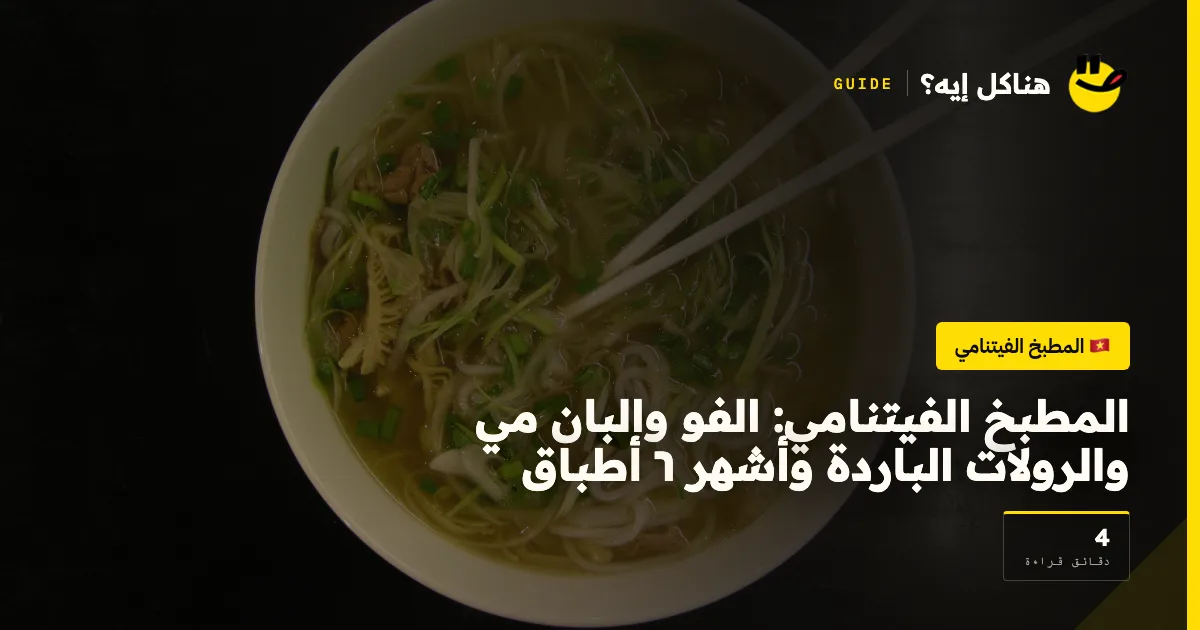
Photo: Jimmy Chen — CC BY-SA 4.0 · Wikimedia Commons
Vietnam is a long country with an enormous coastline, and its cooking reflects two influences: an old Chinese one (noodles, soups and chopsticks) and a modern French one (baguettes, coffee and pâté). The result is a distinctive cuisine that combines the lightness of Asian herbs with European technique — and banh mi is the clearest example: a French baguette with a Vietnamese filling.
The core dishes
1. Pho
A rice noodle soup in a beef bone broth simmered for hours, served with thinly sliced beef and fresh herbs on the side.
The broth must stay clear — the trick is to parboil the bones for five minutes, throw that water away and rinse the bones, then start again. That removes the proteins that cloud it.
No boiling after that — only the gentlest bubbles at the surface. Boiling emulsifies the fat and clouds the broth permanently.
The onion and ginger are charred over a direct flame until blackened before they go into the broth — that is what gives pho its characteristic depth.
2. Banh mi
A sandwich in a Vietnamese baguette — thinner and lighter than the French — with meat, pâté, mayonnaise, pickled vegetables, coriander and chilli.
The pickled vegetables, carrot and daikon, are the star rather than the filling. They pickle in just an hour in vinegar, sugar and water, and provide the acidity that balances the richness.
The baguette is warmed briefly before filling so the crust crisps.
3. Goi cuon (fresh rolls)
Rice paper dipped in warm water for seconds and rolled around prawns, noodles, lettuce and herbs. No frying at all.
Two seconds in the water only — the wrapper finishes softening on the plate. Leave it in and it turns rubbery and tears.
Served with peanut sauce or a sour fish sauce dip.
4. Bun cha
Charcoal-grilled pork placed in a bowl of sweet-sour fish sauce, eaten with cold noodles and herbs.
The sauce is the dish: fish sauce, lime, sugar, water, garlic and chilli, at roughly one part fish sauce, one sugar, one lime and four water — taste and adjust.
Grilled over charcoal rather than in a pan — the smoke is an essential part of the flavour.
5. Fresh herbs
The Vietnamese put a whole plate of herbs on the side with most dishes: mint, basil, coriander, bean sprouts and lettuce, added to taste as you eat.
These are not a garnish — they are genuinely half the dish. Pho without herbs is an ordinary soup.
6. Vietnamese coffee
Very strong coffee dripped slowly through a metal filter over the cup and sweetened with condensed milk.
Ca phe sua da, the iced version, is the best known: dripped onto condensed milk, stirred, and poured over ice.
The French influence
French colonisation left a clear mark: the baguette (which became banh mi), pâté, coffee, and crème caramel (banh flan).
The Vietnamese did not simply copy French food — they took it and altered it. The Vietnamese baguette is made with rice flour alongside wheat, so it comes out lighter and crisper with a thinner crust.
Nuoc cham — the essential sauce
Fish sauce diluted with water, lime, sugar, garlic and chilli. It is served with almost everything, and every family has its own ratio.
The beginner's rule: 4 water : 1 fish sauce : 1 sugar : 1 lime, then taste and adjust to your own palate.
Ingredients worth buying
- Fish sauce: the foundation of almost everything.
- Rice paper: for fresh rolls — buy the thin kind.
- Rice noodles: in different widths depending on the dish.
- Fresh herbs: mint, basil and coriander — by the bunch, not the pinch.
- Sweetened condensed milk: for the coffee.
How a meal is ordered
A Vietnamese meal is served all at once with rice in the centre and a plate of herbs at the side.
Pho is eaten for breakfast in Vietnam, not dinner — the Vietnamese eat it on the street in the morning.
Common mistakes
- Boiling pho broth: it clouds and never clears again.
- Skipping the bone parboil: the broth comes out cloudy and full of scum.
- Soaking rice paper too long: it turns rubbery and tears.
- Neglecting the herbs: the dish loses half its character.
- Cooking bun cha in a pan: the smoke is part of the flavour.
Where to start
Goi cuon is the easiest entry — no cooking at all, just rolling.
Then banh mi, if you can find a good baguette. Bun cha after that, and pho last because its broth takes four to six hours.
How is pho different from ramen?
Both are noodle soups, but the logic is inverted: ramen aims for a cloudy, rich broth (tonkotsu is boiled hard so the fat emulsifies), while pho aims for a clear one through very gentle simmering.
The noodles differ too: ramen uses alkaline wheat, pho uses rice. And the seasoning: ramen relies on tare sauce, pho on cinnamon, star anise and cardamom — genuinely closer to Middle Eastern spicing.
FAQ
How do I get a clear pho broth?
Boil the bones for five minutes, throw the water away and wash them, then start again — that removes the albumin that clouds it. After that, never let it boil; only the gentlest bubbles.
What is the difference between pho and ramen?
The logic is reversed: ramen aims for a rich, cloudy broth and the violent boil is deliberate; pho aims for a clear broth through a very gentle simmer. And the noodles are rice in pho, alkaline wheat in ramen.
Why does my rice paper tear while I roll?
You soaked it too long. Two seconds in warm water is enough — the sheet finishes softening on the plate. Leave it longer and it turns rubbery and tears under your hands.
What is the right ratio for nuoc cham?
For beginners: 4 water : 1 fish sauce : 1 sugar : 1 lime, with garlic and chilli. Taste and adjust after that — every Vietnamese family has its own ratio and personal taste is the judge.

Comments
Cooked it? Tell us how it went, or ask a question — we read every comment.