
Why Molokhia Separates and How to Keep It Thick
Molokhia separates when it boils after being added or when it goes into cold broth. The fix: broth on the point of boiling, the molokhia stirred through for two or three minutes only, and the garlic tempering poured over at the end with the heat turned off immediately.
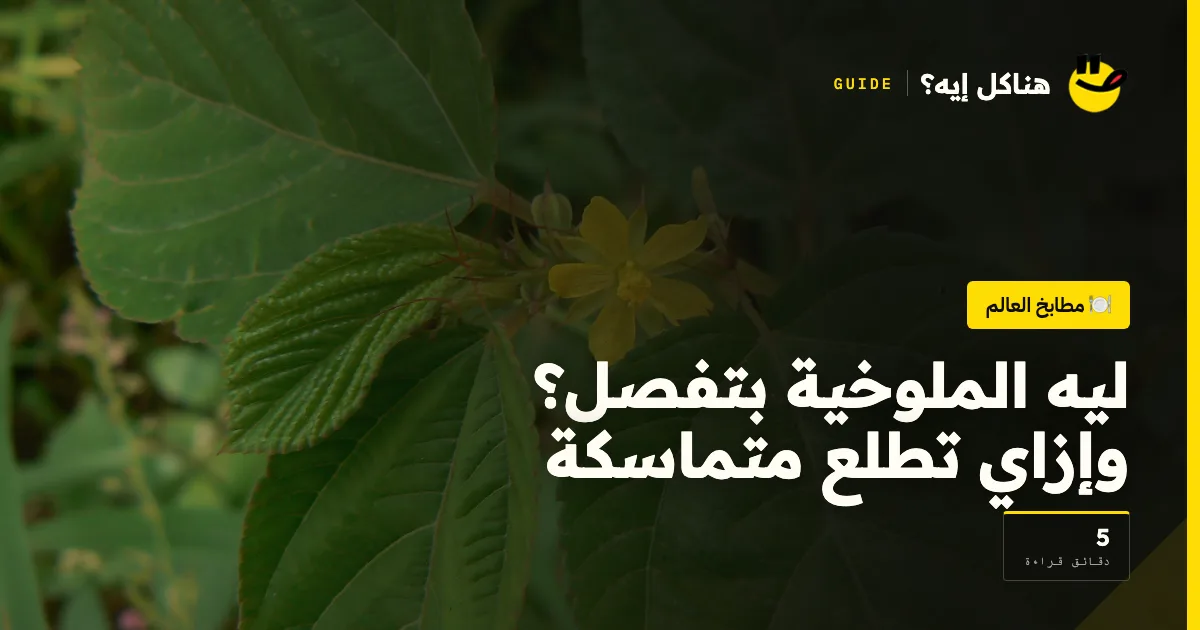
Photo: Dinesh Valke from Thane, India — CC BY-SA 2.0 · Wikimedia Commons
Separated molokhia is a heartbreaking sight: green water on top and leaves settled at the bottom. This is decided in the final three minutes of cooking — not in any step before it.
What holds molokhia together
Molokhia leaves contain mucilaginous compounds (polysaccharides) that dissolve in hot water and give it that characteristic viscous texture.
That viscosity is what keeps the leaf suspended in the broth instead of sinking.
Anything that breaks those mucilage molecules down makes it separate — and the biggest culprit is excess heat.
Cause one: boiling after adding
This is the number one cause without competition.
The moment molokhia goes into the broth, a hard boil breaks the mucilage bonds so it loses its viscosity and the leaf drops.
The golden rule: molokhia never boils. It goes into broth on the point of boiling, is stirred for two to three minutes, and that is all.
If you see large bubbles rising after you add it, the heat is too high.
Cause two: cold broth
If you add molokhia to warm broth and then turn the heat up, it spends a long stretch in the mid-temperature range.
That range gives the enzymes time to break the mucilage down before the heat can deactivate them.
The right way: the broth must be very hot and the molokhia goes in all at once.
Cause three: the wrong stirring
Vigorous stirring, or stirring with a wire whisk, shatters the structure.
Molokhia is stirred with a wooden spoon gently, in a slow circular motion, from the bottom upwards rather than beaten.
The tempering: timing is everything
The tempering (crushed garlic and dried coriander in ghee) is not only for flavour — the fat coats the leaf and helps it hold together.
The correct order:
- The molokhia is stirred into the broth for two or three minutes.
- The tempering is fried separately until the garlic turns golden — not dark.
- It is poured over the molokhia with a hiss.
- The heat goes off immediately and the pot is covered for 5 minutes.
Burnt garlic gives a bitterness that ruins the entire pot — its colour must stop at golden.
Dried vs fresh vs frozen chopped
- Fresh: the highest viscosity and the best flavour — finely chopped and added at the very end.
- Frozen chopped: very close to fresh, and goes in frozen straight onto hot broth without thawing.
- Dried: less viscous, and needs soaking in a little hot broth for 5 minutes first so it rehydrates.
The mistake of thawing first
Frozen molokhia left to thaw on the counter releases a green liquid — and that liquid is the mucilage itself.
In other words, what runs off is exactly what holds the dish together.
The rule: from the freezer straight into the hot broth.
Why it turns dark
A dark or brownish colour means too much heat or too much time.
Chlorophyll breaks down under prolonged heat and shifts from vivid green to dull olive.
Acid darkens it too — so the lemon is squeezed at the table, not into the pot.
The broth: half the success
Molokhia gets its flavour from the broth far more than from the leaf itself.
Rabbit, duck or free-range chicken broth is vastly better than a stock cube.
A good broth: bones and pieces of meat, onion, cardamom and bay, an initial boil with the foam skimmed, then low heat for at least an hour.
And it must be strained before the molokhia goes in — any sediment will settle and look exactly like separation.
The right proportions
The ratio that gives a cohesive texture: roughly one kilo of chopped molokhia to 2 litres of broth.
More broth than that and it is watery; less and it sets like a paste.
If it has already separated
There is no full recovery, but you can improve it:
- Reheat it over very low heat with no boiling, stirring gently.
- Add a fresh second tempering — the fat helps it bind.
- A teaspoon of cornflour dissolved in cold water will fix the texture (an emergency measure, not traditional).
Serving and reheating
Molokhia is served immediately. If any is left, reheat it over low heat with no boiling, stirring gently.
A microwave separates it, because it heats unevenly and boils part of the pot.
It keeps two days in the fridge and freezes well for up to a month.
Fresh leaves: picking and storing
Fresh molokhia leaves are picked from the stem one by one, washed and dried completely before chopping — any excess water dilutes the viscosity.
The traditional two-handled mezzaluna gives a finer texture than a food processor, because the processor crushes the leaf and releases its water rather than cutting it.
To store, chop it dry and pack it flat in bags in the freezer — it keeps a full year and comes out closest to fresh.
Molokhia with rabbit, duck or prawns
Each protein changes the broth and therefore the whole dish. Rabbit gives a light broth and a delicate flavour; duck gives a rich, powerful one that needs a stronger garlic tempering.
Free-range chicken is the most common because it is balanced and carries cardamom and bay well.
Molokhia with prawns (an Alexandrian style) uses a light fish broth, and the prawns go in for the final two minutes only so they do not toughen.
Summary
A clear, very hot broth, molokhia added all at once, two or three minutes of gentle stirring, and the tempering at the end with the heat off immediately. And never a boil after it goes in.
FAQ
How long should molokhia boil?
It does not boil at all. It goes into broth on the point of boiling and is stirred for two or three minutes, and that is it. Boiling breaks down the mucilage holding the leaf in suspension, so it separates and settles.
Should I thaw frozen molokhia first?
No — from the freezer straight into hot broth. If you let it thaw it releases a green liquid, and that liquid is the very mucilage that holds the dish together.
When do I add the garlic tempering?
At the very end. Fry the garlic and coriander until the garlic is golden, not dark, pour it over the molokhia, then turn the heat off immediately and cover for 5 minutes. Burnt garlic gives a bitterness that ruins the pot.
Why does my molokhia turn dark?
Too much heat or too much time broke the chlorophyll down, shifting it from vivid green to olive. Acid darkens it too — so squeeze the lemon at the table rather than into the pot.

Comments
Cooked it? Tell us how it went, or ask a question — we read every comment.