
Roast Beef with Brown Sauce
Roast beef should not be sliced while hot: let it cool for at least an hour (or put it in the fridge), then slice it into half-cm slices against the grain with a sharp knife. Hot meat falls apart under the knife, and slicing with the grain results in rubbery slices even if the piece is well-cooked. Before all of this, it must be cooked over very low heat until a fork goes into the center without resistance.
- Prep
- 20 min
- Cook
- 180 min
- Total
- 260 min
- Calories
- 380
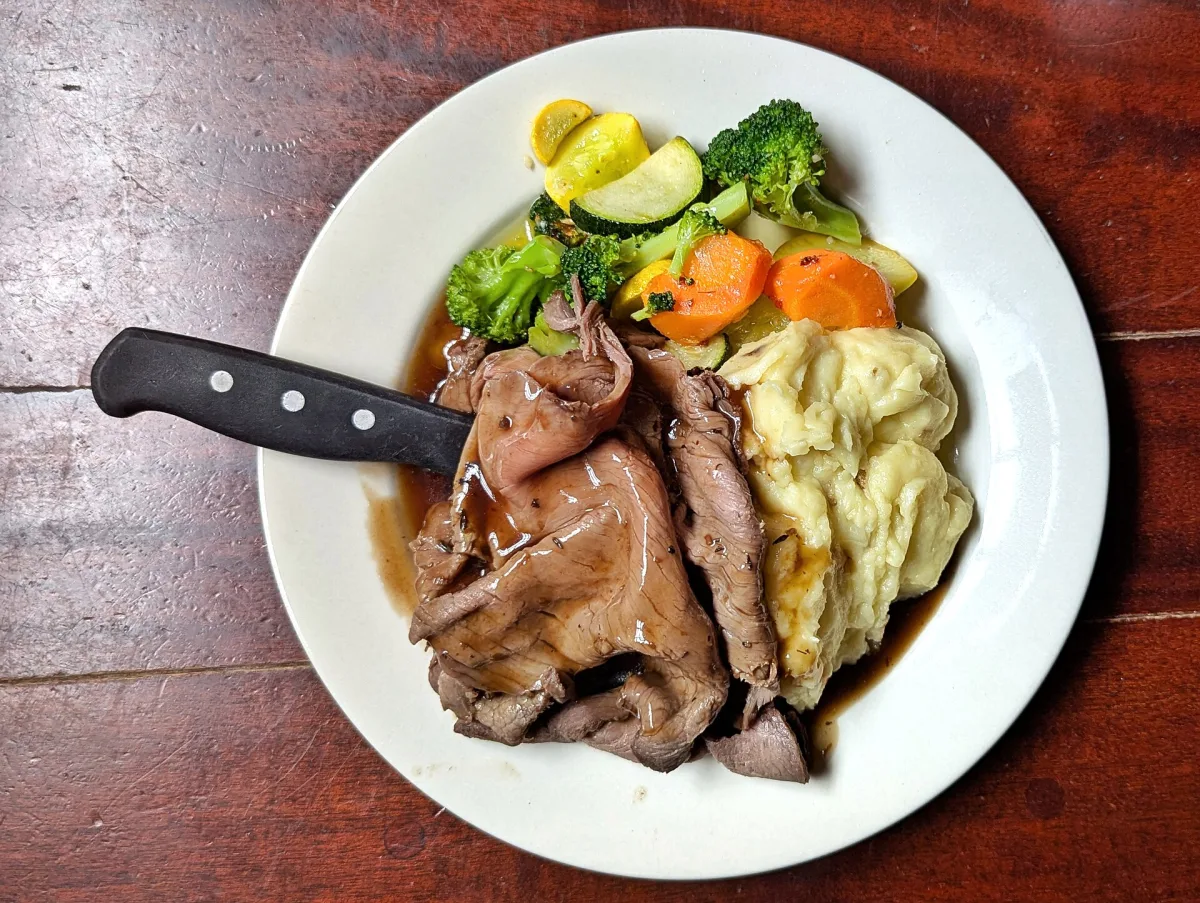
Photo: Daderot / Wikimedia Commons · CC0 · https://commons.wikimedia.org/wiki/File:Roast_beef_with_gravy,_mashed_potato,_and_vegetables_-_Massachusetts.jpg
Roast beef is the centerpiece of feasts in the Egyptian home: a single piece browned and cooked in its broth with onions and cardamom, sliced and arranged in a smooth brown sauce. It is served with white rice, pasta, or mashed potatoes, and its advantage is that it can be made a day ahead and reheated in the sauce without losing quality.
Method
-
1
Piercing the Meat with Garlic
Tie the piece of meat with kitchen twine every 3 cm so it keeps its shape and cooks evenly. Make 8–10 deep holes with a thin knife, push half a clove of garlic into each hole, and then rub the whole piece with vinegar, salt, pepper, and nutmeg.
⏱ 10 min -
2
Browning on All Sides
Heat the oil and ghee in a heavy pot over high heat, and brown the piece for 3 minutes on each side until it takes on a dark brown color all over. This browning is what gives the sauce its color and flavor — roast beef boiled directly yields a pale sauce.
⏱ 12 min -
3
Onions and Spices
Add the onions and carrots around the piece and sauté them for 5 minutes until their edges brown, then add the cardamom, bay leaves, mastic, and cinnamon stick for a minute until their aroma releases.
⏱ 6 min -
4
Cooking on Low Heat
Pour in hot water until it covers half the piece, and as soon as it boils, reduce the heat to the lowest setting and cover the pot. Leave it for 2 to 2.5 hours, turning the piece every half hour. Vigorous boiling tightens the fibers and leaves the meat dry — what is needed is just a gentle simmer on the surface. It is ready when a fork goes into the center and comes out without resistance.
⏱ 135 min -
5
Cooling Before Slicing
Transfer the piece to a plate and let it cool for at least an hour — and if you are making it ahead of time, put it in the fridge wrapped up. Strain the broth and keep it, and skim the layer of fat off the surface with a spoon.
⏱ 60 min -
6
Slicing Against the Grain
Remove the string, look at the direction of the lines in the meat, and slice against them into half-cm slices using a long, sharp knife with a back-and-forth motion without pressing down. A slice cut against the grain comes out tender in the mouth, while one cut with the grain stretches like a rubber band.
⏱ 10 min -
7
The Brown Sauce
Melt the butter over medium heat, add the flour and stir for 2 minutes until its color turns beige and it smells like biscuits. Pour in 3 cups of hot broth gradually while whisking so it doesn't form lumps, add the minced garlic, and let it simmer for 5–7 minutes until it coats the back of a spoon. Taste and adjust the salt.
⏱ 10 min -
8
Reheating in the Sauce
Arrange the slices in a Pyrex dish overlapping like playing cards, drench them in the sauce, and place them in an oven at 180°C for 15 minutes until the sauce bubbles at the edges. Or reheat it in the pot on low heat for 5 minutes without stirring so the slices don't break.
⏱ 15 min
Cooked it? Rate it
Your rating tells the next cook whether this recipe is worth their time.
✓ Thanks — your rating is in.
Tips that actually matter
- If you have time, season the piece after piercing and leave it in the fridge overnight — the flavor penetrates much deeper.
- In a pressure cooker: after browning and adding onions, add only 3 cups of water, and cook for 1 hour from the whistle on low heat, then complete the cooling and slicing normally.
- The slices cut thinner and cleaner if the piece is cold from the fridge — this is the advantage of making it a day before the feast.
- Use any leftover roast broth to cook the rice served alongside it, or freeze it in small containers for soup.
People also ask
Why does the roast beef fall apart when I slice it?
Because it was sliced while hot, or it was overcooked until the fibers completely unraveled. Let it cool for an hour or more, use a long sharp knife, and slice against the grain. If it is truly overcooked, cut it into slightly thicker slices (1 cm) and it will hold together.
Which cut of meat should I ask the butcher for when making roast beef?
Ask for a "roast beef cut" from the eye of round or top round: compact cuts without bones featuring a thin thread of fat that keeps them tender. Tenderloin does not need this long cooking and dries out in it, and cuts with a lot of sinew will fall apart when you slice.
Can I make roast beef with tomato paste instead of brown sauce?
Yes, and this is a popular version in many homes: after the onions brown, add two tablespoons of tomato paste and sauté them for two minutes before the water, and proceed normally. In the end, reduce the broth by boiling uncovered for 10 minutes instead of using flour.
Can I freeze roast beef?
Yes: freeze the slices inside the sauce in a sealed container for up to 3 months. Thaw it in the fridge overnight, reheat it in the oven covered with foil, and if the sauce separates a little, stir it as it warms. The sauce protects the slices from drying out in the freezer.
Cook mode
Roast Beef with Brown Sauce
-
1
Piercing the Meat with Garlic
Tie the piece of meat with kitchen twine every 3 cm so it keeps its shape and cooks evenly. Make 8–10 deep holes with a thin knife, push half a clove of garlic into each hole, and then rub the whole piece with vinegar, salt, pepper, and nutmeg.
-
2
Browning on All Sides
Heat the oil and ghee in a heavy pot over high heat, and brown the piece for 3 minutes on each side until it takes on a dark brown color all over. This browning is what gives the sauce its color and flavor — roast beef boiled directly yields a pale sauce.
-
3
Onions and Spices
Add the onions and carrots around the piece and sauté them for 5 minutes until their edges brown, then add the cardamom, bay leaves, mastic, and cinnamon stick for a minute until their aroma releases.
-
4
Cooking on Low Heat
Pour in hot water until it covers half the piece, and as soon as it boils, reduce the heat to the lowest setting and cover the pot. Leave it for 2 to 2.5 hours, turning the piece every half hour. Vigorous boiling tightens the fibers and leaves the meat dry — what is needed is just a gentle simmer on the surface. It is ready when a fork goes into the center and comes out without resistance.
-
5
Cooling Before Slicing
Transfer the piece to a plate and let it cool for at least an hour — and if you are making it ahead of time, put it in the fridge wrapped up. Strain the broth and keep it, and skim the layer of fat off the surface with a spoon.
-
6
Slicing Against the Grain
Remove the string, look at the direction of the lines in the meat, and slice against them into half-cm slices using a long, sharp knife with a back-and-forth motion without pressing down. A slice cut against the grain comes out tender in the mouth, while one cut with the grain stretches like a rubber band.
-
7
The Brown Sauce
Melt the butter over medium heat, add the flour and stir for 2 minutes until its color turns beige and it smells like biscuits. Pour in 3 cups of hot broth gradually while whisking so it doesn't form lumps, add the minced garlic, and let it simmer for 5–7 minutes until it coats the back of a spoon. Taste and adjust the salt.
-
8
Reheating in the Sauce
Arrange the slices in a Pyrex dish overlapping like playing cards, drench them in the sauce, and place them in an oven at 180°C for 15 minutes until the sauce bubbles at the edges. Or reheat it in the pot on low heat for 5 minutes without stirring so the slices don't break.




Comments
Cooked it? Tell us how it went, or ask a question — we read every comment.