
Muhalabiya with Milk and Mastic
Muhalabiya is a dessert made of milk, starch, and sugar thickened on the stove with rose water. The secret to the silky texture is to dissolve the starch in cold milk before adding it, and to let the mixture boil for two full minutes after it thickens — this boiling removes the raw starch taste.
- Prep
- 10 min
- Cook
- 15 min
- Total
- 25 min
- Calories
- 210
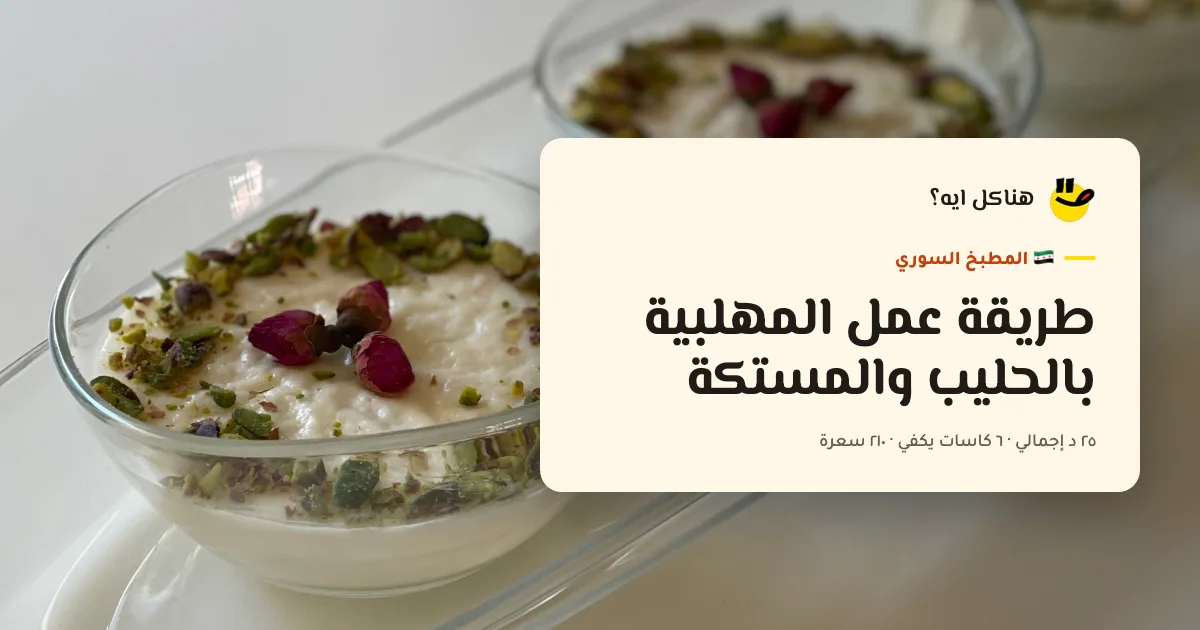
Muhalabiya is one of the simplest and most widespread desserts in the Levant, Egypt, and Turkey. It has only three ingredients, which is why any small mistake shows immediately — and the details are everything.
Method
-
1
Dissolving the Starch
Take one cup of cold milk and dissolve the starch completely in it until there are no lumps. The starch must be dissolved in cold milk — if you put it in hot milk, it will lump instantly and there is no way to fix it afterward except by straining.
-
2
Heating the Milk
Heat the remaining milk with the sugar over medium heat, stirring until the sugar dissolves, just before boiling. Do not let it boil — it will form a skin.
-
3
Incorporating the Starch
Stir the starch mixture again (it settles to the bottom quickly), and pour it in a thin stream into the hot milk with continuous whisking using a wire whisk. Continuous whisking here is not optional — any pause creates lumps.
-
4
Thickening
Continue stirring over medium heat until the mixture thickens and starts to bubble — 5-7 minutes. When it starts making slow, large bubbles, reduce the heat and continue for two full minutes while stirring. These two minutes remove the raw starch taste.
-
5
Flavoring
Turn off the heat and add the rose water, blossom water, and ground mastic, and stir. Add them after the heat because high temperatures evaporate the aromatic oils — this is the most common reason for a muhalabiya with no aroma.
-
6
Pouring
Pour the mixture into the cups while hot through a strainer (a final guarantee against any lumps). And if you want to avoid a skin, cover the top with plastic wrap touching the surface directly.
-
7
Chilling and Garnishing
Let it cool at room temperature for 30 minutes, then refrigerate for at least 4 hours or overnight. Garnish it with crushed pistachios and coconut just before serving — if you put them on early, they will get soggy.
Cooked it? Rate it
Your rating tells the next cook whether this recipe is worth their time.
✓ Thanks — your rating is in.
Tips that actually matter
- Dissolve the starch in cold milk — the most important step to prevent lumps.
- Continuous whisking without stopping while pouring.
- Two minutes of boiling after thickening to remove the raw starch taste.
- Rose water and mastic after turning off the heat.
- Pour it through a strainer as a final guarantee.
People also ask
The muhalabiya has lumps — what do I do?
Strain it through a fine sieve while it is hot, or blend it with an immersion blender. For next time: dissolve the starch in cold milk, and pour it in a thin stream with continuous whisking without stopping.
It tastes like starch — why?
You didn't boil it enough. After it thickens, it must stay on the heat for two full minutes with stirring. The starch needs this time to fully gelatinize and lose its raw taste — this is the most common mistake in the recipe.
It didn't thicken enough — the solution?
Return it to the heat and add a tablespoon of starch dissolved in a quarter cup of cold milk, stir until it thickens, and boil it for two minutes. The guaranteed ratio: 80 grams of starch per liter of milk for a firm consistency that holds its shape when unmolded.
What is the difference between muhalabiya and rice pudding?
Muhalabiya is thickened with starch, has a completely smooth texture, and contains no grains. Rice pudding contains rice grains that release their starch through long boiling. And muhalabiya is much faster — fifteen minutes versus an hour.
Cook mode
Muhalabiya with Milk and Mastic
-
1
Dissolving the Starch
Take one cup of cold milk and dissolve the starch completely in it until there are no lumps. The starch must be dissolved in cold milk — if you put it in hot milk, it will lump instantly and there is no way to fix it afterward except by straining.
-
2
Heating the Milk
Heat the remaining milk with the sugar over medium heat, stirring until the sugar dissolves, just before boiling. Do not let it boil — it will form a skin.
-
3
Incorporating the Starch
Stir the starch mixture again (it settles to the bottom quickly), and pour it in a thin stream into the hot milk with continuous whisking using a wire whisk. Continuous whisking here is not optional — any pause creates lumps.
-
4
Thickening
Continue stirring over medium heat until the mixture thickens and starts to bubble — 5-7 minutes. When it starts making slow, large bubbles, reduce the heat and continue for two full minutes while stirring. These two minutes remove the raw starch taste.
-
5
Flavoring
Turn off the heat and add the rose water, blossom water, and ground mastic, and stir. Add them after the heat because high temperatures evaporate the aromatic oils — this is the most common reason for a muhalabiya with no aroma.
-
6
Pouring
Pour the mixture into the cups while hot through a strainer (a final guarantee against any lumps). And if you want to avoid a skin, cover the top with plastic wrap touching the surface directly.
-
7
Chilling and Garnishing
Let it cool at room temperature for 30 minutes, then refrigerate for at least 4 hours or overnight. Garnish it with crushed pistachios and coconut just before serving — if you put them on early, they will get soggy.




Comments
Cooked it? Tell us how it went, or ask a question — we read every comment.