
Date-Filled Menin Biscuits
Menin biscuits fail for two reasons: dry date paste that hardens in the oven, and dough that has been kneaded too much, making it dry like a biscuit. Cook the date paste with ghee over low heat until it becomes like a paste, bring the dough together without kneading, and put the menin in the oven after only 15 minutes of stamping so the pattern doesn't blur.
- Prep
- 70 min
- Cook
- 40 min
- Total
- 170 min
- Calories
- 295
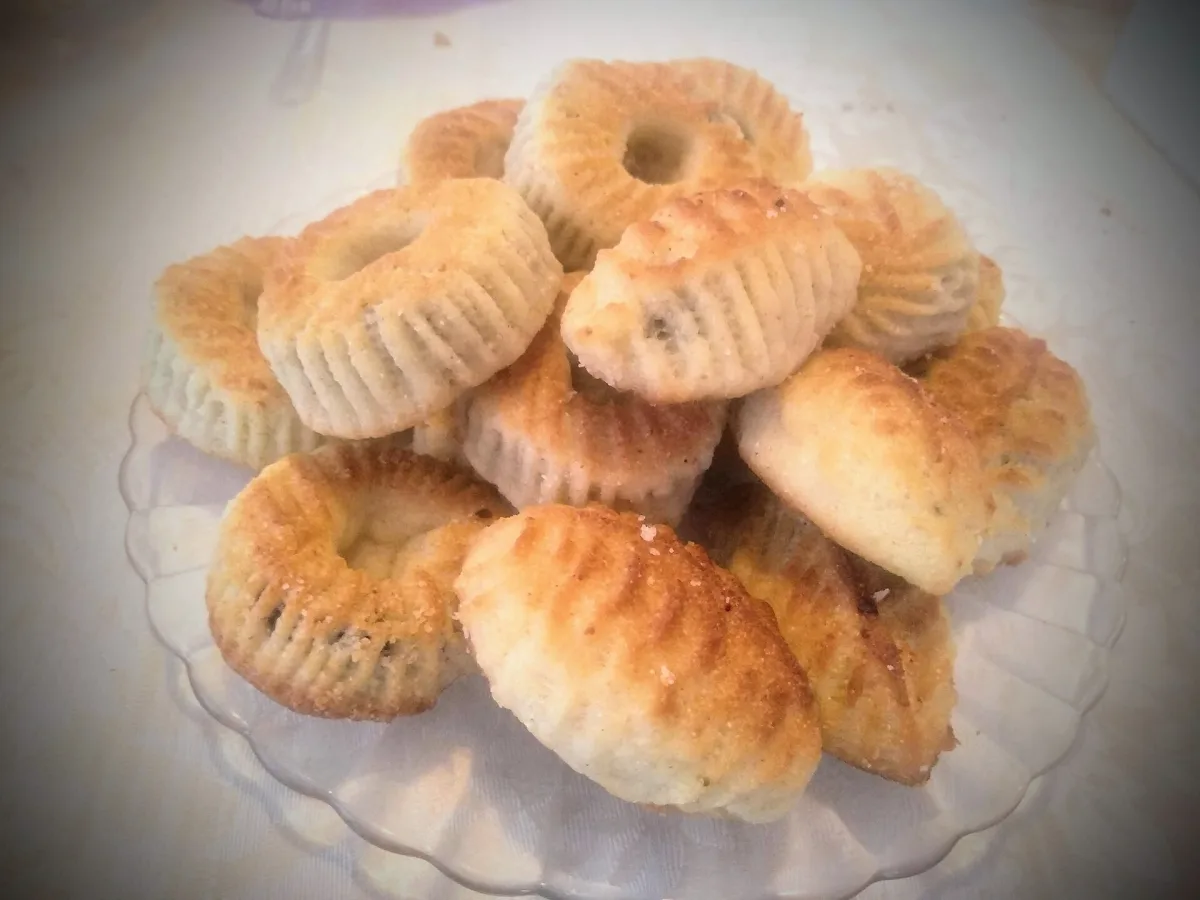
Photo: Fjmustak / Wikimedia Commons · CC BY-SA 4.0 · https://commons.wikimedia.org/wiki/File:%D9%83%D8%B9%D9%83_%D9%88%D9%85%D8%B9%D9%85%D9%88%D9%84.jpg
Menin is similar to kahk in the Egyptian Eid tray: a soft dough made with ghee, milk, and yeast, filled with date paste, and stamped in a wooden menin mold into an oval striped shape. It contains much less ghee than kahk so it comes out softer, and it is eaten with tea all year round, not just on Eid.
Method
-
1
Preparing the Date Filling
Cut the date paste into pieces and place them in a pan with 2 tablespoons of ghee and cinnamon over low heat for 3–5 minutes, mashing with a wooden spoon until it becomes a soft, glossy paste. The ghee prevents the date paste from hardening in the oven. Let it cool, and shape it into 5 cm logs (about 15g each) using hands greased with ghee.
⏱ 15 min -
2
Mixing Dry Ingredients
In a wide bowl, mix the flour, powdered sugar, yeast, baking powder, spice, and salt thoroughly so the yeast and baking powder are evenly distributed throughout the flour and the menin rises evenly.
⏱ 3 min -
3
Rubbing Flour with Ghee
Pour the warm melted ghee over the flour, and rub it between the palms of your hands for 5 minutes until everything is coated and resembles wet sand. The ghee coats the flour so the gluten doesn't develop, which is the secret to the softness that differentiates menin from bread.
⏱ 5 min -
4
Adding Milk and Bringing Dough Together
Add the warm milk gradually while bringing the dough together with your hand until it forms a soft, cohesive ball that doesn't stick — and after that, do not knead at all. You might not need all the milk. Cover it and let it rest for 45 minutes in a warm place; it won't double in size because the ghee slows down the yeast, but it will puff up and soften.
⏱ 50 min -
5
Filling
Take a piece of dough weighing 25g (the size of a walnut), flatten it in your palm into a thin circle, place the date log in the center, seal the dough around it from all sides so the dates don't show, and roll it between your palms into an oval shape.
⏱ 25 min -
6
Stamping in the Mold
Dust the menin mold with flour and tap out the excess, place the piece inside and press it gently until it fills the mold, then tap the edge of the mold against the table once to release it. No mold? Flatten the piece slightly and stamp diagonal lines on it with a maqash (tweezers) or fork tines. Arrange them on an ungreased baking sheet with 2 cm between each piece.
⏱ 20 min -
7
Short Rest
Let the tray rest for only 15 minutes while you preheat the oven to 180°C. A long rest after stamping causes the dough to puff up too much, blurring and erasing the pattern.
⏱ 15 min -
8
Baking
Bake on the middle rack for 15–18 minutes until the bottom turns golden and the top takes on a light golden color. If the top is still pale, turn on the top broiler for 1 minute while standing right next to it. Do not let it get dark — menin continues cooking as it cools.
⏱ 18 min -
9
Cooling and Storing
Let the menin cool completely on the tray before moving it, because it comes out soft and breaks easily when hot. Store in an airtight container, and if you like, dust with powdered sugar before serving.
⏱ 20 min
Cooked it? Rate it
Your rating tells the next cook whether this recipe is worth their time.
✓ Thanks — your rating is in.
Tips that actually matter
- If the dough cracks while you are sealing the date paste, add a tablespoon of warm milk and gently bring it together again.
- Dust the mold with flour every 3–4 pieces — a mold with stuck dough will cause sticking and blurred patterns.
- Can't find kahk spice? Use half a teaspoon of ground mahlab with half a teaspoon of vanilla.
- Soak very hard date paste in a quarter cup of hot water for 10 minutes and drain it before heating.
People also ask
What is the difference between menin, kahk, and maamoul?
Kahk has ghee equal to about three-quarters of the flour weight so it comes out crumbly, round, stamped with tweezers, and filled with agameya, malban, or plain, dusted with sugar. Menin has less ghee than half of the kahk and contains milk, so it comes out soft, filled with dates, and oval-shaped from a mold. Levantine maamoul is made with semolina instead of flour, and filled with dates, pistachios, or walnuts.
Why did my menin turn out hard and the dates hardened?
Hard dough is caused by too much kneading, or extra flour added to stop stickiness, or leaving it in the oven until it darkens. Dates harden if they go in without being softened with ghee over heat. Just bring the dough together, and take them out as soon as the bottom turns golden.
Can I make menin without yeast?
Yes: omit the yeast and make the baking powder two small teaspoons, and bake immediately without resting. It will turn out closer to a crumbly biscuit, and less soft and puffed than menin with yeast.
How long does menin last? Can it be frozen?
In an airtight container away from heat, it stays soft for about two weeks. It can be frozen after baking in a sealed container or bag for 3 months, and thawed at room temperature while still sealed so it doesn't collect moisture.
Cook mode
Date-Filled Menin Biscuits
-
1
Preparing the Date Filling
Cut the date paste into pieces and place them in a pan with 2 tablespoons of ghee and cinnamon over low heat for 3–5 minutes, mashing with a wooden spoon until it becomes a soft, glossy paste. The ghee prevents the date paste from hardening in the oven. Let it cool, and shape it into 5 cm logs (about 15g each) using hands greased with ghee.
-
2
Mixing Dry Ingredients
In a wide bowl, mix the flour, powdered sugar, yeast, baking powder, spice, and salt thoroughly so the yeast and baking powder are evenly distributed throughout the flour and the menin rises evenly.
-
3
Rubbing Flour with Ghee
Pour the warm melted ghee over the flour, and rub it between the palms of your hands for 5 minutes until everything is coated and resembles wet sand. The ghee coats the flour so the gluten doesn't develop, which is the secret to the softness that differentiates menin from bread.
-
4
Adding Milk and Bringing Dough Together
Add the warm milk gradually while bringing the dough together with your hand until it forms a soft, cohesive ball that doesn't stick — and after that, do not knead at all. You might not need all the milk. Cover it and let it rest for 45 minutes in a warm place; it won't double in size because the ghee slows down the yeast, but it will puff up and soften.
-
5
Filling
Take a piece of dough weighing 25g (the size of a walnut), flatten it in your palm into a thin circle, place the date log in the center, seal the dough around it from all sides so the dates don't show, and roll it between your palms into an oval shape.
-
6
Stamping in the Mold
Dust the menin mold with flour and tap out the excess, place the piece inside and press it gently until it fills the mold, then tap the edge of the mold against the table once to release it. No mold? Flatten the piece slightly and stamp diagonal lines on it with a maqash (tweezers) or fork tines. Arrange them on an ungreased baking sheet with 2 cm between each piece.
-
7
Short Rest
Let the tray rest for only 15 minutes while you preheat the oven to 180°C. A long rest after stamping causes the dough to puff up too much, blurring and erasing the pattern.
-
8
Baking
Bake on the middle rack for 15–18 minutes until the bottom turns golden and the top takes on a light golden color. If the top is still pale, turn on the top broiler for 1 minute while standing right next to it. Do not let it get dark — menin continues cooking as it cools.
-
9
Cooling and Storing
Let the menin cool completely on the tray before moving it, because it comes out soft and breaks easily when hot. Store in an airtight container, and if you like, dust with powdered sugar before serving.



Comments
Cooked it? Tell us how it went, or ask a question — we read every comment.