
Aleppo Krabij with Natif Cream
Krabij succeeds with two things: the semolina is rubbed with ghee and rested for at least 4 hours (or overnight) before kneading so the piece is tender and doesn't crack, and the natif is whipped from soapwort root water boiled with thick hot syrup until glossy white and holding peaks like meringue. The krabij itself is baked until only the bottom is golden while the top stays pale.
- Prep
- 60 min
- Cook
- 55 min
- Total
- 10 hr
- Calories
- 695
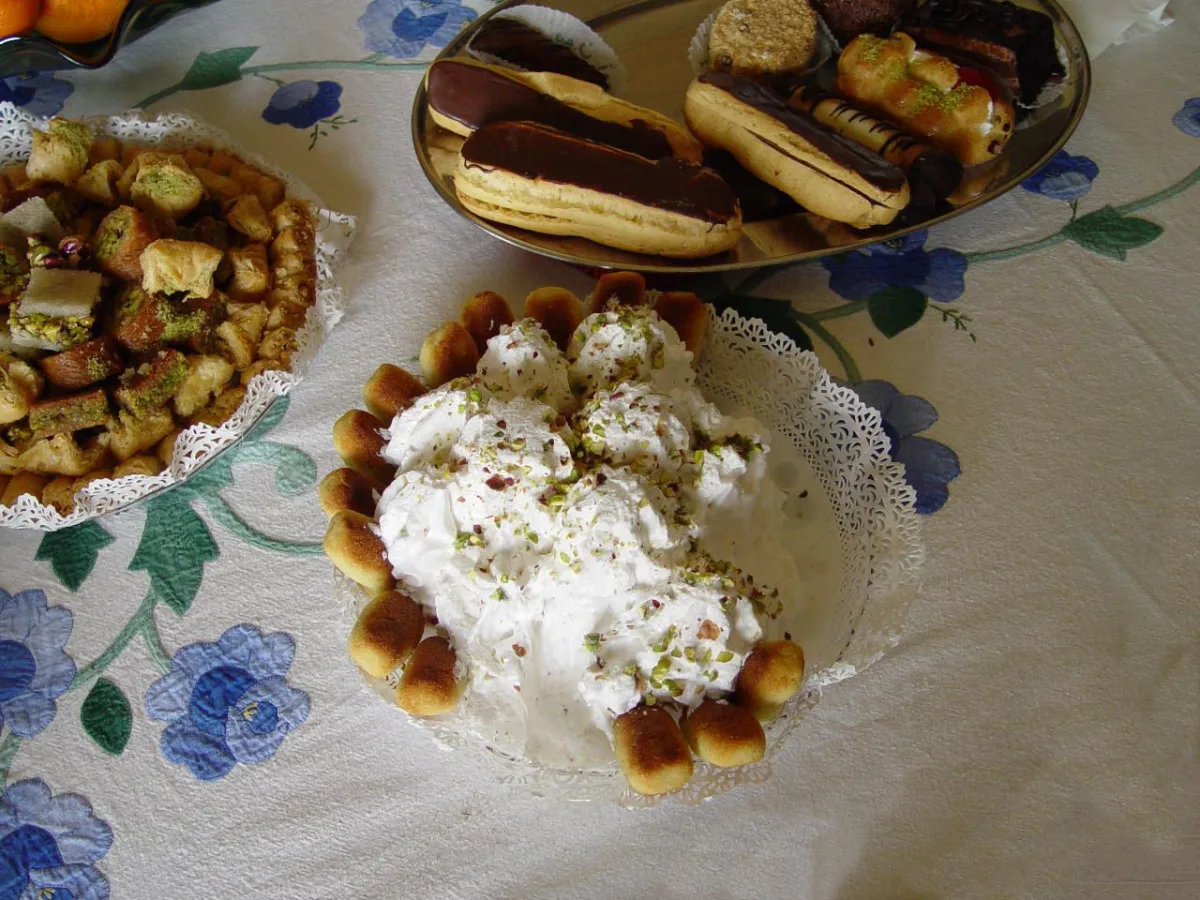
Photo: Serge Melki from Indianapolis, USA / Wikimedia Commons · CC BY 2.0 · https://commons.wikimedia.org/wiki/File:Lebanon_-_Baklava_-_Karabij_-_Eclair_(2318962553).jpg
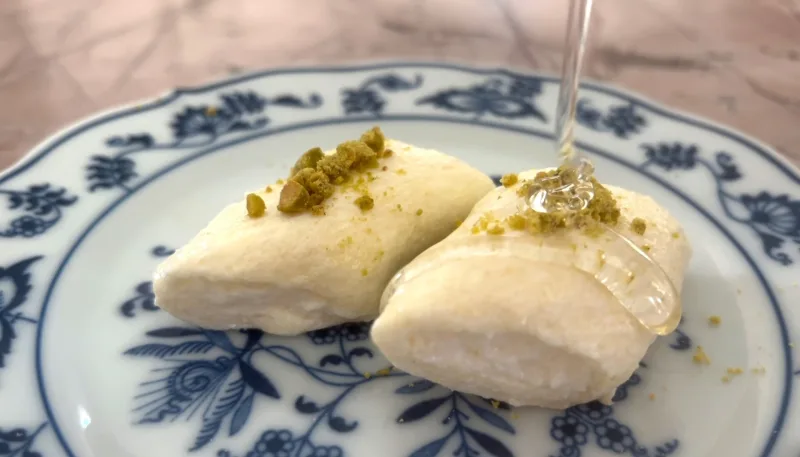
Krabij is one of the most famous sweets of Aleppo: semolina and ghee fingers stuffed with cinnamon walnuts, served covered with natif — a cloud-light white cream made from soapwort root (known at the herbalist in Egypt as "arq el-halawa") with simple syrup. Its shape is close to maamoul but without a mold, and its tender taste melts with the coolness and sweetness of the natif.
Method
-
1
Rubbing the Semolina Overnight
In a wide bowl, put the semolina, sugar, mahlab, and salt, pour in the melted ghee, and rub with your hand for 5 minutes until every grain of semolina is coated and resembles wet sand. Cover it and leave it for at least 4 hours or overnight outside the fridge; the semolina absorbs the ghee and softens, and without this resting time, the krabij will crack and turn out sandy.
⏱ 5 min -
2
Soapwort Root Water
At the same time, wash the soapwort root and soak it in 3 cups of water overnight. The next day, boil it in its water over medium heat for 20–25 minutes until the water reduces to half a cup and its color turns light brown, strain it through a fine sieve, and let it cool completely.
⏱ 25 min -
3
Walnut Filling
Mix the coarsely chopped walnuts with sugar, cinnamon, and rose water. Do not grind the walnuts finely; the small pieces provide a crunch inside the piece and prevent it from releasing oil.
⏱ 5 min -
4
Gentle Kneading
Sprinkle the warm water and orange blossom water onto the rested semolina in batches, and gather it with your hand in a gentle motion until it becomes a soft dough that doesn't stick. Do not knead it much; excessive kneading makes it rubbery and the piece turns out tough instead of tender.
⏱ 5 min -
5
Shaping the Fingers
Take a ball the size of a walnut (30–35 g), open it with your finger like a cup with a thin wall, put a teaspoon of walnuts, close it, and roll it between your palms into an oval finger 7 cm long with slightly tapered ends. Arrange them on an ungreased tray with a finger's distance between them.
⏱ 30 min -
6
Baking Until the Bottom is Golden
Preheat the oven to 200 °C, and bake the tray on the middle rack for 15–18 minutes until the bottom is golden and the top remains pale with a slight inclination to color. Let it cool in the tray for 10 minutes before moving it; while hot, it is tender and breaks.
⏱ 18 min -
7
Natif Syrup
Boil 2 cups of sugar with half a cup of water and lemon juice for 8–10 minutes until it becomes a thick syrup: a drop of it between two fingers (after cooling for a second) forms a thread, or 115 °C if you have a thermometer. Light syrup causes the natif to sag and melt.
⏱ 10 min -
8
Whipping the Natif and Serving
In the mixer bowl, put the cold root water and whip it on high speed for 3–4 minutes until it froths, whitens, and thickens like egg whites, and add the egg white if you are using it. Pour the hot syrup in a thin stream down the side of the bowl while the mixer is running, and continue whipping for 10 minutes with the orange blossom water until it becomes glossy white and holds peaks. Serve the krabij with a spoonful of natif next to or on top of each piece.
⏱ 15 min
Cooked it? Rate it
Your rating tells the next cook whether this recipe is worth their time.
✓ Thanks — your rating is in.
Tips that actually matter
- Soapwort root is sold at the herbalist (it is the same thing that goes into halawa tehina), and its quantity is small: 15 grams is enough. Excess of it gives a slight bitterness in the natif.
- No soapwort root? Make a quick natif from 3 egg whites whipped with hot syrup in the same way — the taste is close and the texture is slightly thicker.
- Natif is made on the day of serving and kept in the fridge for one day covered, while the krabij itself lives in a closed box for two weeks outside the fridge.
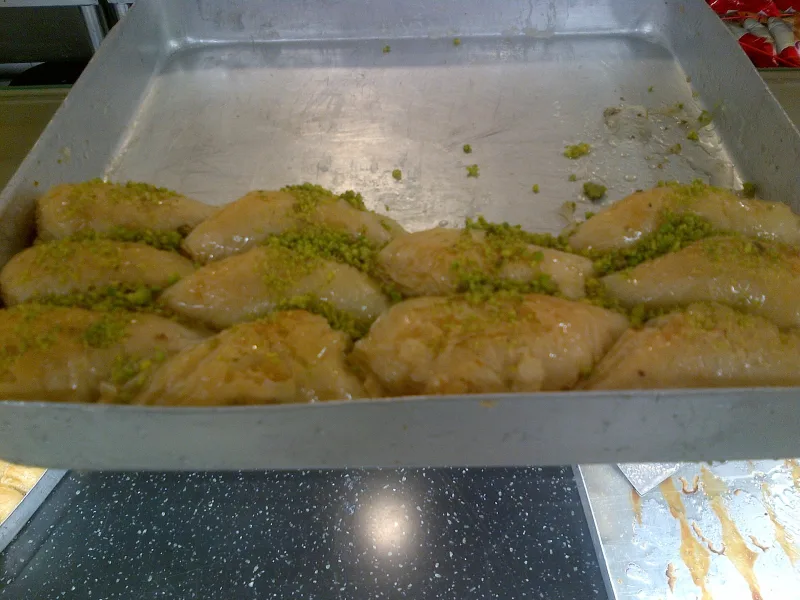
- Want it with pistachios? Replace the walnuts with chopped Aleppo pistachios in the same quantity — these are pistachio krabij, and they are served with the same natif.
People also ask
Why does the krabij crack while shaping or in the oven?
Cracking means the semolina didn't absorb enough ghee or the dough is dry. Let the rubbed semolina rest for at least 4 hours, add water by the spoon until the dough is soft and smooth between your fingers, and if it cracks while rolling, wet your hand with a drop of water.
Why does natif sag and melt after a while?
Usually the syrup was light, or it was poured while not hot enough, or the whipping was insufficient. The syrup must reach the thread stage (about 115 °C) and be poured hot while you are whipping, continue for 10 minutes until the natif holds peaks and is glossy, and keep it covered in the fridge.
What is soapwort root and where do I get it?
It is a plant root sold dry at herbalists, and in Syria it is called shars al-halawa. Its boiled water froths heavily and this is what gives the natif its texture, and it is used in Levantine sweets and halawa tehina in small quantities like the one in the recipe. Do not increase the amount, and if you can't find it, use egg whites instead.
What is the difference between krabij and maamoul?
Both are semolina and ghee dough stuffed, but maamoul is shaped in an engraved mold and baked until golden and dusted with powdered sugar. Krabij is shaped by hand into smooth fingers, stays pale, and is eaten with white natif.
Cook mode
Aleppo Krabij with Natif Cream
-
1
Rubbing the Semolina Overnight
In a wide bowl, put the semolina, sugar, mahlab, and salt, pour in the melted ghee, and rub with your hand for 5 minutes until every grain of semolina is coated and resembles wet sand. Cover it and leave it for at least 4 hours or overnight outside the fridge; the semolina absorbs the ghee and softens, and without this resting time, the krabij will crack and turn out sandy.
-
2
Soapwort Root Water
At the same time, wash the soapwort root and soak it in 3 cups of water overnight. The next day, boil it in its water over medium heat for 20–25 minutes until the water reduces to half a cup and its color turns light brown, strain it through a fine sieve, and let it cool completely.
-
3
Walnut Filling
Mix the coarsely chopped walnuts with sugar, cinnamon, and rose water. Do not grind the walnuts finely; the small pieces provide a crunch inside the piece and prevent it from releasing oil.
-
4
Gentle Kneading
Sprinkle the warm water and orange blossom water onto the rested semolina in batches, and gather it with your hand in a gentle motion until it becomes a soft dough that doesn't stick. Do not knead it much; excessive kneading makes it rubbery and the piece turns out tough instead of tender.
-
5
Shaping the Fingers
Take a ball the size of a walnut (30–35 g), open it with your finger like a cup with a thin wall, put a teaspoon of walnuts, close it, and roll it between your palms into an oval finger 7 cm long with slightly tapered ends. Arrange them on an ungreased tray with a finger's distance between them.
-
6
Baking Until the Bottom is Golden
Preheat the oven to 200 °C, and bake the tray on the middle rack for 15–18 minutes until the bottom is golden and the top remains pale with a slight inclination to color. Let it cool in the tray for 10 minutes before moving it; while hot, it is tender and breaks.
-
7
Natif Syrup
Boil 2 cups of sugar with half a cup of water and lemon juice for 8–10 minutes until it becomes a thick syrup: a drop of it between two fingers (after cooling for a second) forms a thread, or 115 °C if you have a thermometer. Light syrup causes the natif to sag and melt.
-
8
Whipping the Natif and Serving
In the mixer bowl, put the cold root water and whip it on high speed for 3–4 minutes until it froths, whitens, and thickens like egg whites, and add the egg white if you are using it. Pour the hot syrup in a thin stream down the side of the bowl while the mixer is running, and continue whipping for 10 minutes with the orange blossom water until it becomes glossy white and holds peaks. Serve the krabij with a spoonful of natif next to or on top of each piece.

Comments
Cooked it? Tell us how it went, or ask a question — we read every comment.