
Syrian Shakriya with Yogurt and Meat
The secret to Shakriya is that the yogurt is whisked with starch and egg white while cold, then placed over medium heat with continuous stirring without stopping until it boils (10–15 minutes), and the salt and broth are added only after boiling. If you leave it without stirring or salt it while cold, it will curdle and become grainy.
- Prep
- 15 min
- Cook
- 130 min
- Total
- 145 min
- Calories
- 445
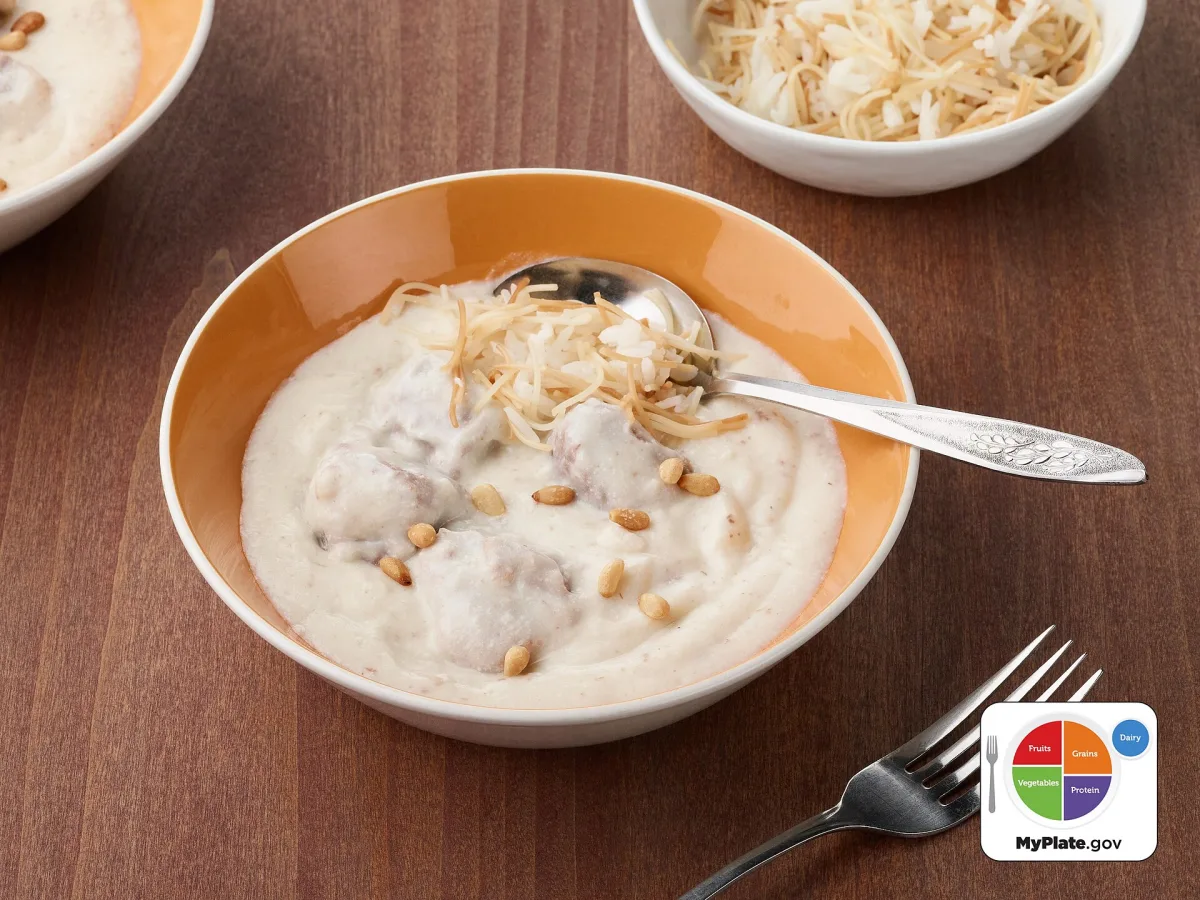
Photo: USDAgov / Wikimedia Commons · Public domain · https://commons.wikimedia.org/wiki/File:MyPlate_gov_Cultural_Food_(20241025-USDA-FNS-UNK-0046).jpg
Shakriya is one of the most famous dishes of the Levant, especially Damascus: bone-in lamb or veal shank pieces boiled with cardamom, bay leaves, and spices until melt-in-your-mouth tender, then simmered in a smooth, cream-like cooked yogurt sauce. It is served hot alongside vermicelli rice and garnished with toasted pine nuts. It has a mildly tangy and warm flavor—a classic for gatherings and wintertime among Syrians.
Method
-
1
First Boil
Place the meat cubes in a pot and cover with cold water, let it come to a boil over high heat, and skim off the foam that rises to the surface with a spoon for 5 minutes until the water is clear. If left, the foam will cloud the broth and cause an off-smell.
⏱ 10 min -
2
Boiling with Spices
Add the onion, cardamom, bay leaves, allspice berries, cinnamon, and half a teaspoon of salt. Lower the heat, cover the pot, and cook for 1.5 to 2 hours — or 35–40 minutes in a pressure cooker — until a fork easily pierces the meat. Remove the meat, strain the broth, and reserve 1 cup of it.
⏱ 100 min -
3
Whisking Cold Yogurt
In a clean, heavy-bottomed pot while cold, whisk the yogurt until smooth. Dissolve the starch in a quarter cup of cold water, add it along with the egg white, and whisk again until completely free of lumps. The starch and egg white hold the yogurt protein together during boiling so it doesn't curdle.
⏱ 5 min -
4
Stirring Until Boiling
Place the pot over medium heat and stir with a wooden spoon without stopping — in one direction as the Levantines say — uncovered, for 10–15 minutes until the yogurt thickens, starts to boil, and bubbles appear on the surface. Do not add salt or broth before boiling, as they cause it to curdle.
⏱ 15 min -
5
Adding Meat and Broth
As soon as it boils, add the meat, broth, and remaining salt, continue stirring, lower the heat, and let it gently simmer for 10 minutes until the consistency resembles light cream and the meat is heated through and absorbs the flavor. If it becomes too thick, thin it with a little hot broth.
⏱ 10 min -
6
Toasting Pine Nuts
In a small pan, melt the ghee over low heat and sauté the pine nuts for 2–3 minutes until they take on a light golden color, then remove them immediately because they continue cooking in the hot ghee and will burn in seconds.
⏱ 3 min -
7
Serving
Ladle the hot Shakriya into deep bowls, pour the pine nuts and their ghee over top, and serve alongside vermicelli rice. Eat it hot right away, because if it cools down, it thickens and loses its smoothness.
⏱ 2 min
Cooked it? Rate it
Your rating tells the next cook whether this recipe is worth their time.
✓ Thanks — your rating is in.
Tips that actually matter
- Use fresh, full-fat yogurt; low-fat or old, very sour yogurt curdles faster even with starch. If your yogurt has a lot of whey, strain out a quarter cup of it first.
- For chicken: use 1 chicken cut into 6 pieces or bone-in breasts, boil with the same spices for 35–40 minutes only, and proceed with the rest of the steps as written.
- Many Damascene households finish Shakriya with a sauté of minced garlic and dried mint in a spoonful of ghee poured over the pot at the end — optional if you like the taste of garlic.
- Want the Damascene "Ummahu" version? Add half a kilo of small peeled onions with the meat in the last half hour of boiling, and simmer them in the yogurt together.
People also ask
Why does the yogurt curdle (separate) in Shakriya?
Yogurt curdles when its proteins clump from heat without something to hold them together. The most common reasons are not adding starch, stopping stirring before it boils, salting or pouring broth while it's still cold, or using too high heat. Whisk it with starch and egg white while cold, and stir continuously over medium heat until it boils.
Can I make Shakriya without eggs?
Yes. Increase the starch to 3 tablespoons for 1.5 kg of yogurt and dissolve it well in cold water, and strictly commit to continuous stirring. The egg white provides extra security, but starch alone is enough as long as the heat is medium and stirring never stops.
Which meat is best for Shakriya?
The best cuts have bone and cartilage like the shoulder or shank, because they yield a rich broth and keep the meat tender. Lamb is traditional in the Levant, and veal works the same way. Avoid filet and lean, dry cuts because they dry out with long boiling.
Can I reheat Shakriya or freeze it?
It can be stored in the fridge for two days and reheated over low heat with a little broth or water and continuous stirring without letting it boil hard. Freezing is not suitable because cooked yogurt separates and becomes grainy after thawing. If you want to prepare ahead, freeze the boiled meat in its broth and cook the yogurt on the day of serving.
Cook mode
Syrian Shakriya with Yogurt and Meat
-
1
First Boil
Place the meat cubes in a pot and cover with cold water, let it come to a boil over high heat, and skim off the foam that rises to the surface with a spoon for 5 minutes until the water is clear. If left, the foam will cloud the broth and cause an off-smell.
-
2
Boiling with Spices
Add the onion, cardamom, bay leaves, allspice berries, cinnamon, and half a teaspoon of salt. Lower the heat, cover the pot, and cook for 1.5 to 2 hours — or 35–40 minutes in a pressure cooker — until a fork easily pierces the meat. Remove the meat, strain the broth, and reserve 1 cup of it.
-
3
Whisking Cold Yogurt
In a clean, heavy-bottomed pot while cold, whisk the yogurt until smooth. Dissolve the starch in a quarter cup of cold water, add it along with the egg white, and whisk again until completely free of lumps. The starch and egg white hold the yogurt protein together during boiling so it doesn't curdle.
-
4
Stirring Until Boiling
Place the pot over medium heat and stir with a wooden spoon without stopping — in one direction as the Levantines say — uncovered, for 10–15 minutes until the yogurt thickens, starts to boil, and bubbles appear on the surface. Do not add salt or broth before boiling, as they cause it to curdle.
-
5
Adding Meat and Broth
As soon as it boils, add the meat, broth, and remaining salt, continue stirring, lower the heat, and let it gently simmer for 10 minutes until the consistency resembles light cream and the meat is heated through and absorbs the flavor. If it becomes too thick, thin it with a little hot broth.
-
6
Toasting Pine Nuts
In a small pan, melt the ghee over low heat and sauté the pine nuts for 2–3 minutes until they take on a light golden color, then remove them immediately because they continue cooking in the hot ghee and will burn in seconds.
-
7
Serving
Ladle the hot Shakriya into deep bowls, pour the pine nuts and their ghee over top, and serve alongside vermicelli rice. Eat it hot right away, because if it cools down, it thickens and loses its smoothness.


Comments
Cooked it? Tell us how it went, or ask a question — we read every comment.